Christuskirche, Protestant church in Westend, Frankfurt, Germany.
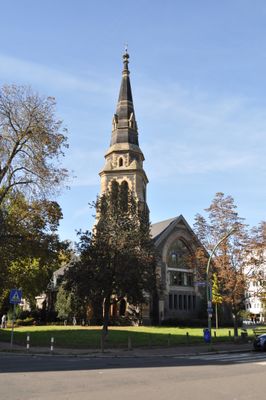
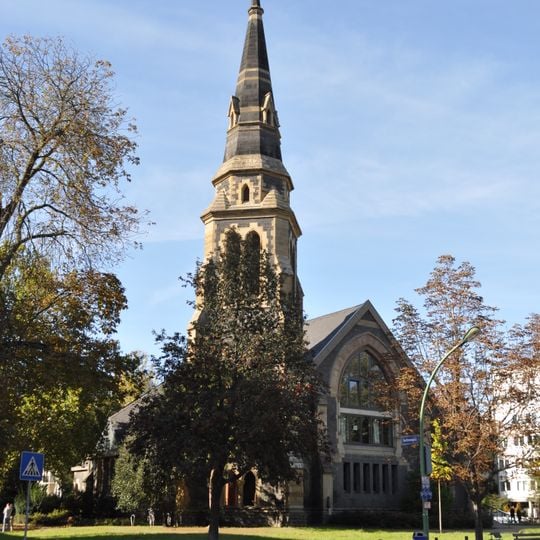
Christuskirche is a neo-Gothic, three-nave basilica on Beethovenplatz in Frankfurt's Westend-Süd, built 1881–1883 to a design by Danish-born architect Aage von Kauffmann, who drew on medieval churches of Brittany and England. Rough natural stone walls are articulated by dressed buttresses and jambs, the aisle roofs are pulled low, and the bell tower with the main entrance sits rotated about 45° beside the nave. Tracery windows shape the facade.
The Christuskirche was built from 1881 to 1883 on Beethovenplatz by the Frankfurter evangelisch-kirchlicher Hülfsverein, a personal parish founded by the merchant and theologian Emil Moritz von Bernus (1843–1913) after the consistorial church could not finance a new building in the growing Westend. The city council rejected the building application; only the vote of mayor Johannes von Miquel let it proceed. Architect Aage von Kauffmann, born in Denmark, designed a Neo-Gothic three-aisled basilica modelled on medieval churches of Brittany and England. Damaged in the air raids of 4 October 1943 and 18 March 1944, it stood as a ruin for over thirty years and was rebuilt in 1976–77, reopening on 28 February 1978 as an ecumenical centre.
Since 1978 the building has been an ecumenical centre shared by three congregations: the Protestant Christus-Immanuel parish, a Serbian Orthodox community and Frankfurt's East African Oromo congregation. Each group fitted out its own chapel in the former side aisles and apse according to its liturgy, and mobile wooden walls let the central nave be opened up for larger celebrations.
The main entrance sits beneath the bell tower, which is rotated about 45 degrees beside the nave on Beethovenplatz. Since 1978 the interior has been divided into chapel-like rooms in the former side aisles and apse, opened to the central nave by sliding wooden walls; each of the three congregations arranges its own space for its liturgy.
The smallest bell survived the church fire of 1944 and was rehung; the two larger bells had been given up for armament in 1939. Cast by Rincker in 1933 at 300 kg, it bears the inscription "Ewiges Leben" (eternal life).
The community of curious travelers
AroundUs brings together thousands of curated places, local tips, and hidden gems, enriched daily by 93,044 contributors worldwide.