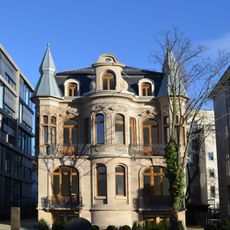
Senckenberg Museum, Natural history museum in Westend-Süd, Frankfurt, Germany.
Senckenberg Museum is a natural history institution in Westend-Süd, Frankfurt, with several exhibition halls filled with fossils, taxidermied animals, and minerals. The rooms display reconstructed dinosaur skeletons, glass cases holding bird specimens from around the world, and rocks documenting millions of years of Earth's story.
The museum opened on 13 October 1907 in a neo-baroque building by architect Ludwig Neher, built outside Frankfurt's old centre next to what became Goethe University in 1914. It grew from the 1817 Senckenberg Nature Research Society and a public natural history cabinet founded in 1821 near the Eschenheimer Tor. The American Museum of Natural History donated an 18-metre Diplodocus skeleton for the opening.
The museum's name refers to Johann Christian Senckenberg, who in 1763 left his fortune of 95,000 guilders to found a hospital and fund scientific work; he died in 1772. The society that runs the museum was founded in 1817 by 32 Frankfurt citizens, who received permission from the Senckenberg foundation, partly at Goethe's suggestion, to use his name. The mascot is a Triceratops, shown as a complete cast.
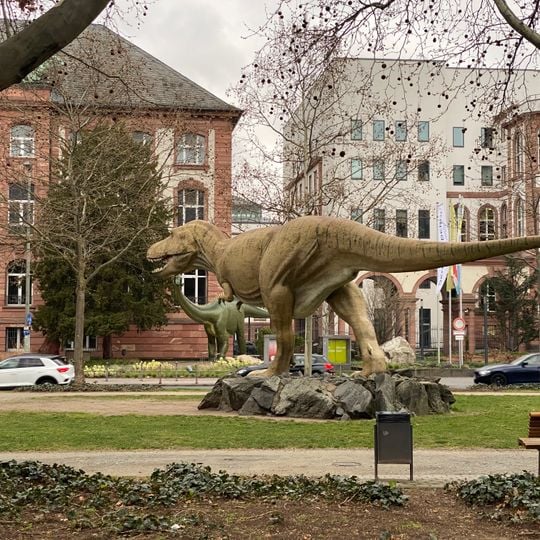
The museum sits on Senckenberganlage in Westend-Süd, enclosed on three sides by the Bockenheim campus of Goethe University. The entrance is on the forecourt, where a Tyrannosaurus rex replica stands. Inside, a reconstructed Titanosaurus track set into the floor leads into the covered courtyard with the dinosaur skeletons. The exhibition area covers about 6,000 m².
The Psittacosaurus specimen SMF R 4970 from Liaoning, China, preserves bristles around its tail and fossilized stomach contents; in 2022 researchers identified a belly button in it. The museum also keeps one of twenty surviving quagga specimens, a zebra relative extinct since 1883.
The community of curious travelers
AroundUs brings together thousands of curated places, local tips, and hidden gems, enriched daily by 92,843 contributors worldwide.