Marktschlößchen, Renaissance mansion at Market Square, Halle, Germany
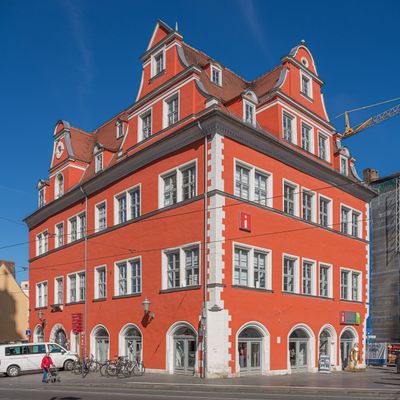
Marktschlößchen is a three-wing Renaissance house at Marktplatz 13 in Halle, built on a small footprint around a castle-like inner courtyard. Its east main wing turns a show facade to the market, with representative portals and windows decorated with tracery. A stair tower with a Welsche Haube rises above the building, linked to one wing by a wooden gallery; the steep saddle roofs carry large dormers and early Baroque swan-neck gables.
Built in the second half of the 16th century as a patrician Renaissance house, it was owned early on by Kilian Stisser, chancellor of the Lutheran administrator Christian Wilhelm von Brandenburg. From 1654 Konrad Carpzov, chancellor under August von Sachsen-Weißenfels, lived here; in 1675 Alexander Haubold Marschall von Bieberstein bought it. Pharmacist Christian Friedrich Zepernick installed a pharmacy in 1746; his son Karl Friedrich Zepernick, the last Salzgraf of Halle, was born here in 1751. After 1918 the city owned it, briefly housing the town archive and council library; since 1975 it has served cultural purposes.
The name Marktschlößchen probably dates to 1883, when innkeeper Julius Just ran a restaurant and café of that name on the first floor; the castle-like look may explain an older origin. The house was long called Zepernickes Haus after pharmacist Christian Friedrich Zepernick, who bought it in 1746 and installed a pharmacy; his son Karl Friedrich Zepernick, born here in 1751, became Halle's last Salzgraf. Today the ground floor holds the tourist information, the university shop and a Halloren café.
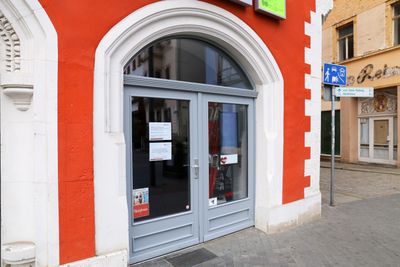
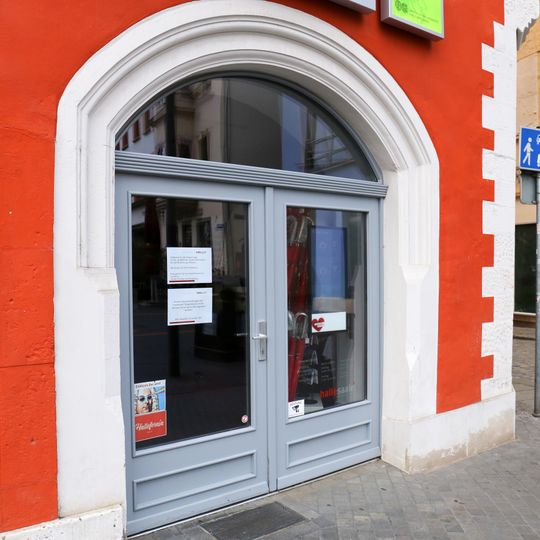
The ground floor of the Marktschlößchen at Marktplatz 13 holds the city's tourist information desk, a university shop and a Halloren café. The entrance is the arched double door with the "Hallefornia" poster on the red facade; the corner of the building carries a small red "i" sign. The upper floors are reached by the stair tower and are not part of the ground-floor visit.
The name's origin is unresolved: it likely dates to 1883, when innkeeper Julius Just ran a restaurant and café called Marktschlößchen on the first floor, though the castle-like look may have inspired it earlier. The house was listed as a monument in 1935.
The community of curious travelers
AroundUs brings together thousands of curated places, local tips, and hidden gems, enriched daily by 92,850 contributors worldwide.