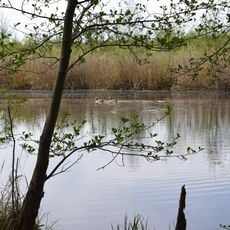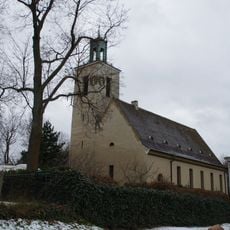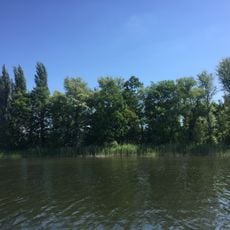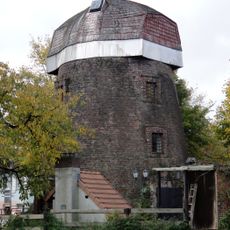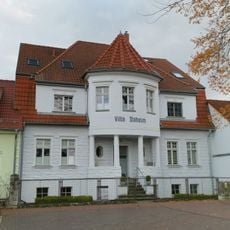
Lock Plaue, Navigation lock in Brandenburg an der Havel, Germany
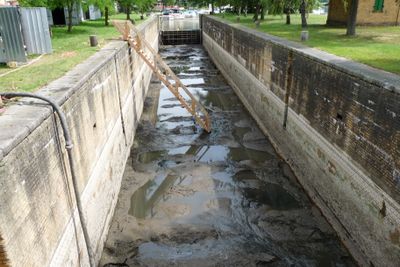
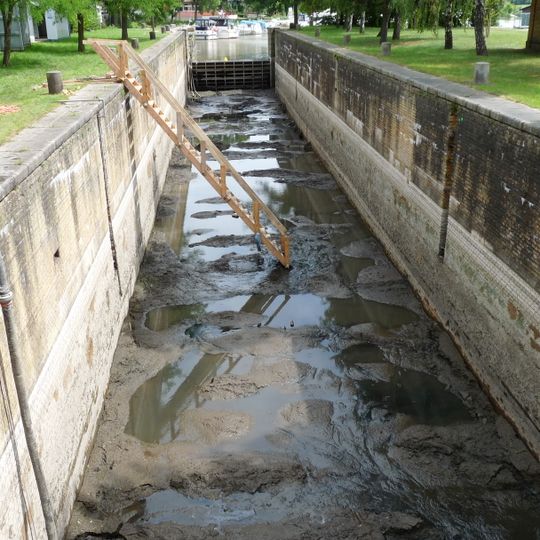
Lock Plaue is a navigation lock on the Woltersdorfer Altarm section of the Plauer Canal that controls water levels between different parts of the waterway. The structure has chambers and gates designed to manage significant height differences in the water.
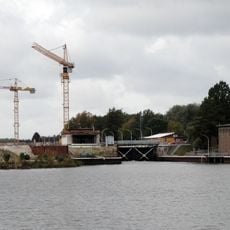
The Plauer Canal was built under Frederick II between 1743 and 1745 to link the Havel lakes near Brandenburg with the Elbe, shortening the route between Berlin and Magdeburg. Three locks were built along it, including Plaue, where a wooden lock was replaced in 1781. A solid chamber lock followed in 1821–1823, and a larger chamber of 67 by 8.60 metres was added in 1884–1886. When the Elbe-Havel Canal was built from the 1920s, the Plaue lock lay on the bypassed Woltersdorfer arm and was taken out of service, replaced by the Wusterwitz lock.
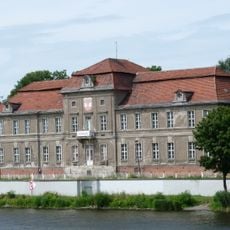
The name comes from the Plaue district of Brandenburg an der Havel, where the lock lies in the Woltersdorfer Altkanal. Since 2010 the north chamber has housed a small hydroelectric plant with a double-regulated Kaplan tubular turbine, producing about 437,000 kWh per year.
The lock is out of service: since the opening of the Elbe-Havel Canal and the Wusterwitz Lock it no longer handles boat traffic, so no passage can be planned. Its chamber is fitted with a weir in the upper head, and a small hydropower plant (built 2010) with a Kaplan tubular turbine of about 95 kW now sits in the north chamber.
The lock is out of service, but its north chamber houses a small hydroelectric plant installed in 2010: a double-regulated Kaplan tubular turbine producing about 95 kW and roughly 437,000 kWh per year. The chamber is not part of the Elbe-Havel Canal, which bypasses this old arm.
The community of curious travelers
AroundUs brings together thousands of curated places, local tips, and hidden gems, enriched daily by 94,646 contributors worldwide.