St. Elisabeth, Abbey church in Munich, Germany.
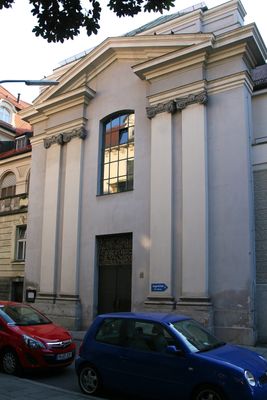
St. Elisabeth is a Rococo-style church in Munich with white walls and curved lines that define both its interior and exterior. The building showcases intricate decorative details including columns, ornaments, and stucco work throughout its design.
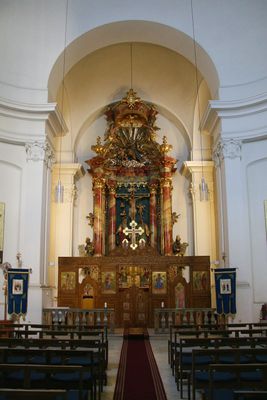
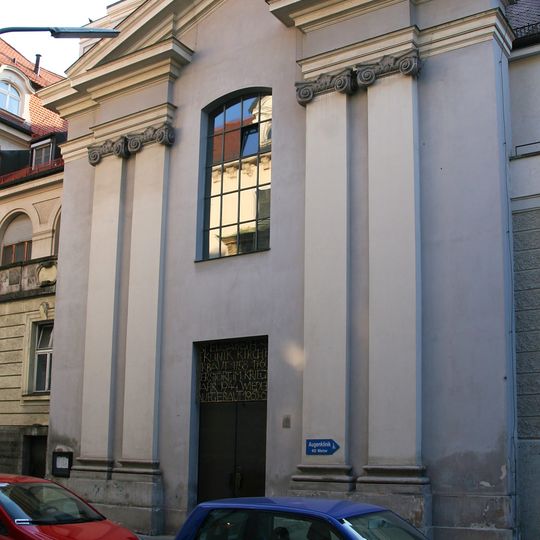
Construction began in 1758, likely under court mason Leonhard Matthäus Giessl; an attribution to Johann Michael Fischer is no longer considered certain. The facade with double pilasters was completed only in 1790 by Franz Kirchgrabner. The church was heavily destroyed in World War II and simplified by Erwin Schleich; the high altar by Joseph Heringer after a design by Ignaz Günther was reconstructed in simplified form in 1947.
The church is used today by the Romanian Greek-Catholic community for its services, while remaining part of the St. Peter parish. The 1732–1763 inscription over the door records the original build; the line "ZERSTORT IM KRIEG 1944 WIEDER AUFGEBAUT 1955" marks the wartime destruction and the 1955 rebuilding. The high altar of 1776, designed by Ignaz Günther and carved by Joseph Heringer, was simplified in 1947 after its figures were recovered from the rubble.
The church is easily reached by public transportation with nearby tram and bus stations offering convenient access. Visitors should check opening times in advance and respect the quiet environment when inside.
The high altar was made by Joseph Heringer in 1776 to a design by Ignaz Günther; its figures were recovered from the wartime rubble and the altar was rebuilt in simplified form in 1947. The pulpit survived the same way, while the two side altars, the stucco and Matthäus Günther's painting were not restored.
The community of curious travelers
AroundUs brings together thousands of curated places, local tips, and hidden gems, enriched daily by 92,641 contributors worldwide.