Neutorbrücke, Road bridge and cultural heritage monument in Ulm, Germany
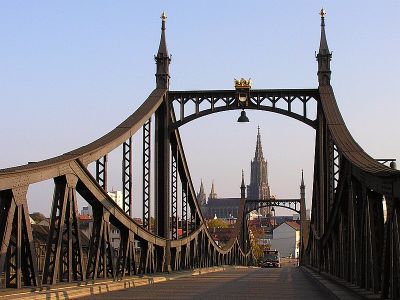
The Neutorbrücke is a 112.2 m long road bridge over the Filstalbahn and Brenzbahn railway tracks in Ulm. Its riveted iron truss spans three openings of 28.90 m, 54.40 m and 28.90 m, carried by two concrete piers. Iron pylons above the piers are linked by a rounded crossbeam to form a portal, and the pylons end in neo-Gothic turrets with gilded tips.
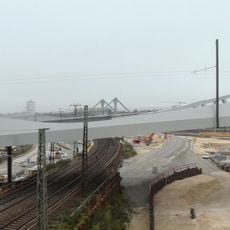
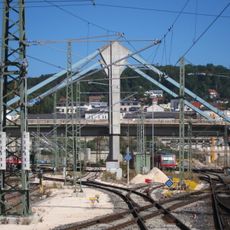
The Neutorbrücke was built between 1906 and 1907 for the Königlich Württembergische Staats-Eisenbahnen, to plans by the Stuttgart engineers Levi and Büttner, by the Maschinenfabrik Esslingen, so that the Neutorstraße could cross the Filstalbahn and Brenzbahn tracks. It was renovated from 1987 to 1989 and placed under monument protection in 1990. In 2018 the Kienlesbergbrücke was added beside it for the new tram line to the Wissenschaftsstadt on the Oberer Eselsberg.
The gilded crowns at the apex of the bridge's arches carry Ulm's coat of arms, and the pylons end in neo-Gothic turrets with gilded tips. The bridge was built for the Royal Württemberg State Railways, so its ornament joins city identity with railway engineering.
The bridge sits near Ulm's main railway station and serves both vehicles and pedestrians as a central crossing point. You can easily access it from Kienlesbergstrasse, which offers a direct viewing angle.
The bridge's iron pylons are joined by a pierced crossbeam into a single portal, and gilded crowns sit at the arch apexes bearing Ulm's coat of arms. The upper pylon ends carry neo-Gothic turrets with gilded tips. The riveted truss rests on two stamped-concrete piers and spans three openings of 28.90 m, 54.40 m and 28.90 m.
The community of curious travelers
AroundUs brings together thousands of curated places, local tips, and hidden gems, enriched daily by 93,900 contributors worldwide.