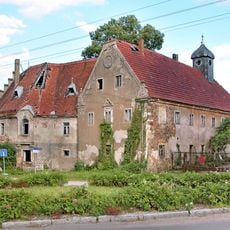
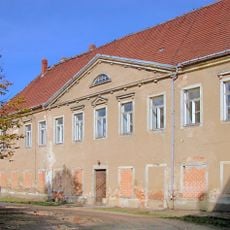
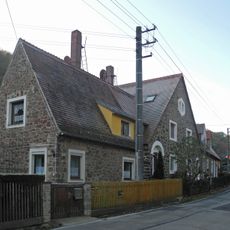
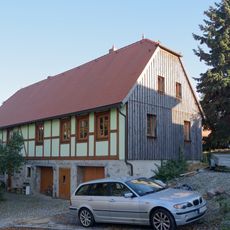
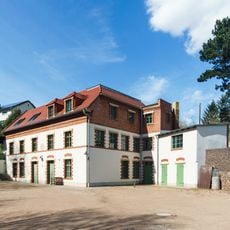
Schloss Weistropp, Heritage château in Weistropp, Saxony, Germany.
Schloss Weistropp is a castle in Klipphausen located on elevated ground near a church and displaying Saxon architectural features with multiple wings and floors. The structure has been extensively renovated and now serves as residential apartments.
A Sattelhof and Vorwerk were recorded at Weistropp in 1413, and a Rittergut emerged by 1551. Heinrich von Eckersberg had a new Schloss built in 1601; Albrecht von Güntherode added the south and north wings in 1661/1662. Adolph Freiherr von Seifertitz, royal Polish and Saxon chief kitchen master, bought the estate in 1717 and had it substantially rebuilt in 1723, when a passage to the church's patronal box was made.
The village church stands just a short distance from the south wing, and in 1723 a covered passage was built linking the castle to the church's patron's box, so the lords of Weistropp could reach their pew without stepping outside. The estate also kept its own Rittergut building west of the courtyard.
The castle sits on slightly elevated ground, requiring attention when entering, especially in wet or poor weather conditions. As a private residential complex, access is limited and visitor respect for residents' privacy is important.
Robert Krause, nephew of the art collector Jacob von Krause, was a skilled painter; he completed his painting of Schloss Weistropp on 27 July 1832, showing the castle together with the neighbouring Lutheran church. The work records the complex before the renovations of 1873/1874 and the later changes.
The community of curious travelers
AroundUs brings together thousands of curated places, local tips, and hidden gems, enriched daily by 93,131 contributors worldwide.