Niederwartha Elbe Bridges, Bridge group spanning the Elbe River between Dresden and Radebeul, Germany
The Niederwartha Elbe Bridges consist of two independent structures crossing the river between Dresden and Radebeul. One carries vehicle traffic while the other structure alongside it handles railway transport across the water.
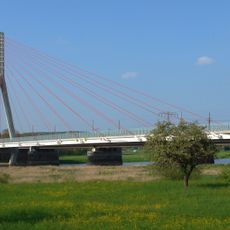
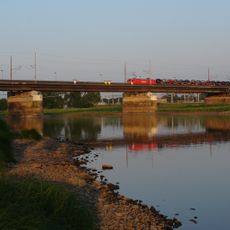
The railway bridge was built between 1873 and 1875 for the Berlin–Dresden line, with three steel rhombus trusses spanning 62 m each over the Elbe. On 8 May 1945 a Wehrmacht commando and an SS unit blew it up; on 31 July 1945 a test train caused the remaining span to collapse, killing fireman Mohr and an unknown Soviet soldier. A provisional track reopened on 13 April 1946, and the bridge was replaced between 1977 and 1983. The road bridge, Germany's longest composite cable-stayed bridge at 192 m main span, opened on 12 December 2011.
The railway bridge carried road traffic until 1945, when a Wehrmacht commando and an SS unit blew it up on 8 May to stop Soviet troops crossing. A provisional footbridge and later a ferry kept the crossing alive until one track reopened on 13 April 1946. The road bridge, Saxony's first cable-stayed bridge, opened on 12 December 2011.
Pedestrians and cyclists cross the Elbe on the railway bridge, which carries a combined foot and cycle path; the road bridge has two lanes and is not intended for pedestrians or cyclists. The two structures run parallel about 10 m apart, with piers aligned, and the road bridge stands downstream of the railway bridge.
The road bridge features an internal pylon access system with elevators that enables crews to reach inspection and maintenance areas through dedicated pathways. This approach to bridge upkeep is uncommon and shows how engineering decisions address practical long-term care.
The community of curious travelers
AroundUs brings together thousands of curated places, local tips, and hidden gems, enriched daily by 94,391 contributors worldwide.