Saint Mary Church, church building in Germany
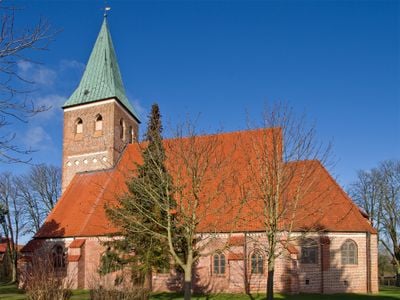
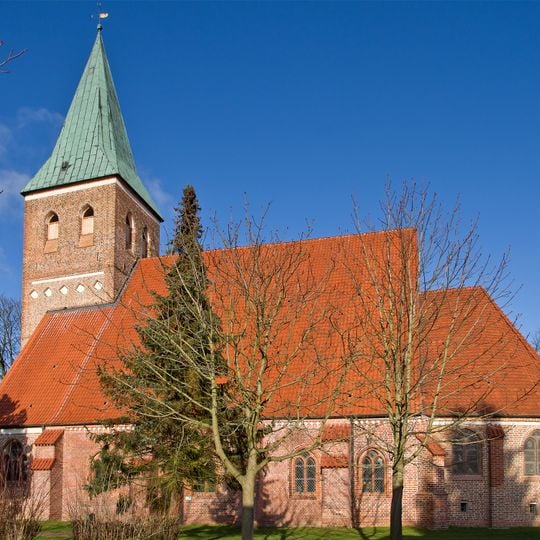
Saint Mary Church in Plate is a three-aisled Brick Gothic building with a polygonal choir and an enclosed west tower. The tower, topped by a green pyramidal spire with a weathervane, has narrow pointed-arch windows and a band of white diamond-shaped stones. The church is almost 35 m long, over 23 m wide, and the nave is 10.5 m high; the tower reaches 42.10 m.
The church's origins lie in the 13th century, when the nave was built with massive walls and round arches, likely as a Cistercian foundation. From 1370 five brothers of the von Plato family enlarged it in Gothic style, adding the tower with two bells, the side aisles and the star vaults. The last major expansion took place between 1472 and 1492, when the sacristy was built and the aisles were joined to the tower. The Reformation was introduced in 1530, and the first Protestant pastor was the former Catholic priest who had served the parish since 1520.
The name refers to a legend: a hunter named Plato found a Marian image on the site, vowed to build a church there, and had it dedicated to the Virgin Mary. Inside, the wall painting "The Last Judgment" shows four Cistercian nuns received by a widow in Plate, figures also depicted in a painting at Medingen Monastery.
The church stands on a low rise in the middle of Plate, on a near-circular churchyard enclosed by a road. The soft, swampy ground of the Jeetzel lowland has caused settling and cracks, so the masonry and windows were repeatedly repaired, most recently in 2009–2011. The tower reaches 42.10 m.
The tower, 42.10 metres high, holds two bells installed from 1370, when five brothers of the von Plato family enlarged the church in Gothic style. Their mason marks are still visible in the brickwork. The tower is the tallest element of a building almost 35 metres long.
The community of curious travelers
AroundUs brings together thousands of curated places, local tips, and hidden gems, enriched daily by 92,632 contributors worldwide.