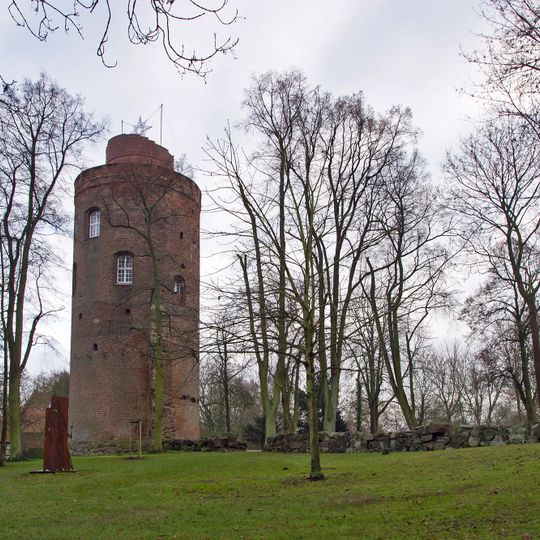
Schloss Lüchow, Medieval castle ruins in Lüchow, Germany
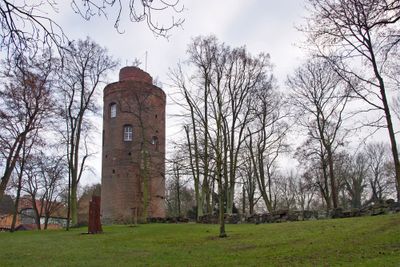
Schloss Lüchow survives as the Amtsturm, a round five-storey tower about 22 metres high, with a fieldstone base and brick walls up to 3.5 metres thick. Its narrow upper turret, originally 12 metres tall, marks it as a Butterfassturm, a form brought from the Rhineland by Countess Anna of Nassau-Dillenburg. Wall stubs remain at two sides up to about 10 metres.
A Slavic ringwall stood on the sand island from around 1040, with palisade timbers dated to 1058; it burned in 1072 and 1085. The castle was first documented in 1144 as the seat of the Counts of Warpke, who took the name Counts of Lüchow. In 1274 the Dukes of Brunswick-Lüneburg sold town and castle to Brandenburg, then bought the county back in 1320. Anna of Nassau-Dillenburg, who stayed in Lüchow from 1471 to 1473, is credited with building the castle, which burned in the town fire of 1811.
The tower museum displays exhibits about the region's history and Slavic roots that shaped the area. Visitors can learn how people lived in this part of Lower Saxony and what influences defined their way of life.
Visitors can climb the tower's five floors and enjoy views of the town and surrounding countryside from different heights. The access is straightforward and allows for multiple viewing points depending on which level you reach.
Archaeological excavations revealed that the castle was built on top of an earlier Slavic fortress that measured about 75 meters across. This discovery shows that the area was home to Slavic peoples long before German settlement.
The community of curious travelers
AroundUs brings together thousands of curated places, local tips, and hidden gems, enriched daily by 92,670 contributors worldwide.