Gottfried-Krüger-Brücke, bridge in Germany
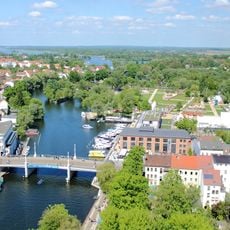
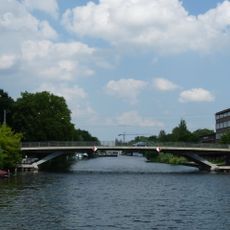
The Gottfried-Krüger-Brücke is a steel footbridge over the Pumpergraben, a small former navigable side arm of the Havel, on the Heinrich-Heine-Ufer in Brandenburg an der Havel. Its single arch rises steeply, giving it the nickname "Bauchschmerzenbrücke". The crossing is stepped; a level bypass was built beside the old bridge in 2014.
The bridge opened in 1922 after earlier plans for a larger road bridge faced local objections in the 1890s. Following World War I, new plans emerged for a riverside pedestrian path, which eventually led to construction of this smaller, more affordable footbridge.
The bridge is named after Kommerzienrat Gottfried Krüger, who donated the funds for its construction. Locals call it "Bauchschmerzenbrücke" (bellyache bridge) because of its strong curvature. The nickname ties to a tale of a drunken miller at the Mostrichmühle who dropped a vinegar barrel into the Pumpergraben, making the bridge "cringe" with stomach pain.
The bridge has steps and is therefore not barrier-free; in 2014 a level bypass was built alongside the old bridge to make crossing easier. It carries pedestrians over the Pumpergraben at the Heinrich-Heine-Ufer, on the edge of the Niederhavel.
At the end of the Pumpergraben stood a Mostrichmühle, a mustard mill. Its miller came home drunk from the tavern one day, quarrelled with his wife, and returned to the mill in a bad mood. An vinegar barrel slipped from his hands into the water, and the sour mixture supposedly made the bridge curl up with stomach ache.
The community of curious travelers
AroundUs brings together thousands of curated places, local tips, and hidden gems, enriched daily by 93,649 contributors worldwide.