Heilig Kreuz, Parish church in Polling, Germany.
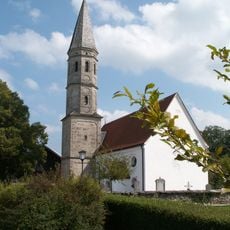
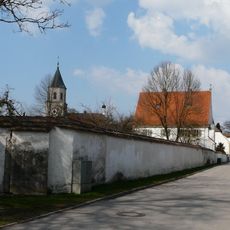
Heilig Kreuz is a three-aisled hall church with five bays, built of Polling tuff. Pointed Gothic arcades rest on tall octagonal piers decorated with Baroque stucco. The choir has three bays and ends in a five-eighth close. The west facade's south side carries the unfinished bell tower begun in 1605, topped in 1822 with an octagon and spire reaching about 57 metres.
A Benedictine monastery founded around 750 by the Huosi family stood here until Hungarian raids destroyed it in the 10th century. In 1010 Duke Henry IV established a collegiate foundation, converted after 1100 into an Augustinian canonry whose church was consecrated in 1160. A cross pilgrimage arose in the 13th century; the church built on this site was destroyed in 1414 and rebuilt in Gothic style between 1416 and 1420. The tower, begun in 1605 to plans by Hans Krumpper, was left unfinished for lack of money.
The church carries two titles: the Finding of the Cross and Sankt Salvator, being consecrated to Christ as Salvator Mundi. A 15th-century legend traced the site's origin to Duke Tassilo III of Bavaria, who was said to have chased a doe that scratched a cross from the ground where the monastery was later built. The Tassilo Cross, a panel crucifix painted around 1230/40, is still venerated here.
The church is accessible to visitors during worship services and is centrally located within Polling. You should check service times before visiting to plan your trip accordingly.
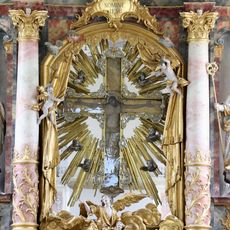
The Tassilo Cross, the church's most valuable piece, was carved from spruce boards felled between 884 and 1018. Around 1180 the brittle wood was covered with horsehide to hide the metal clamps holding it together, and around 1230/40 it was painted with a life-size Crucified Christ.
The community of curious travelers
AroundUs brings together thousands of curated places, local tips, and hidden gems, enriched daily by 94,049 contributors worldwide.