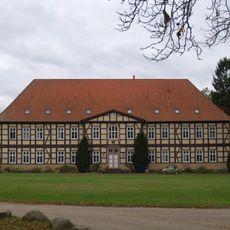
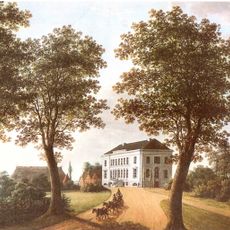
Herrenhaus Tüschow, Manor house in Tüschow, Vellahn, Germany.
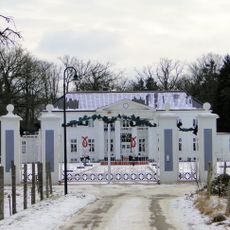
Herrenhaus Tüschow is a two-story residential building with nine window axes constructed in classical style. A broad portico with four Ionic columns marks the main entrance, while a flat hipped roof caps the structure.
Johann Georg von Stern, named Drost of Mecklenburg-Schwerin in 1789 and court huntsman in 1808, commissioned the house in 1830; it was designed by Schwerin architect Ludwig Bartning and built on the foundations of an earlier structure. Von Stern died in Lüneburg on 14 September 1835, shortly after completion. The estate stayed with the von Stern family until Heino von Stern sold the 901-hectare property to Ewald Julius von Hennig in 1913; the Mangels family held the reduced 315-hectare estate from 1935 until expropriation in autumn 1945.
The estate's name comes from the village of Tüschow, not from a family; the manor was built for Johann Georg von Stern, whose Lüneburg printer family was ennobled in 1645. His son Georg Paul Friedrich Carl Ludolph von Stern was master of the Boizenburg Masonic lodge Vesta zu den drei Türmen from 1860 until his death in 1890. The building is privately owned and not open to visitors.
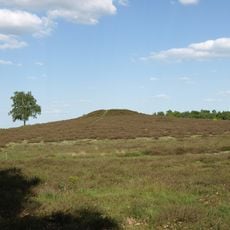
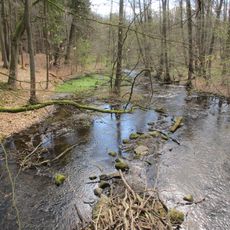
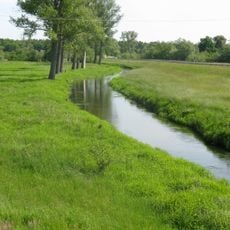
The manor house is privately owned and not open to visitors; it can only be viewed from outside. It stands at the edge of the Schaalelauf nature reserve near Tüschow, part of the municipality of Vellahn in the Ludwigslust-Parchim district. The building was restored according to monument-preservation standards between 1998 and 2002 using documents from its 1830–35 construction period.
The manor stands at the edge of the Schaalelauf nature reserve. Its 30 by 15 metre brick body was built on the foundations of the predecessor building, and the four Ionic columns of the portico once carried a gable triangle decorated with the coat of arms of the respective owner.
The community of curious travelers
AroundUs brings together thousands of curated places, local tips, and hidden gems, enriched daily by 94,645 contributors worldwide.