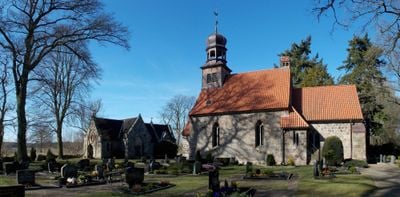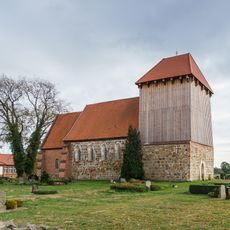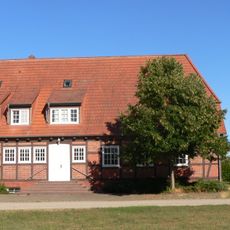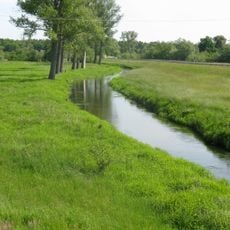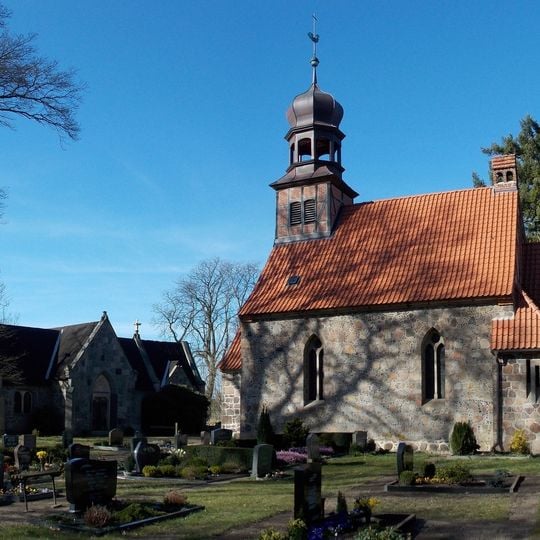
Church in Marsow, Fieldstone church in Vellahn, Germany.
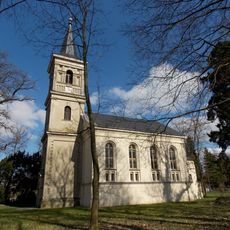
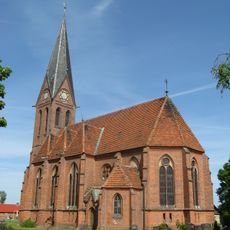
The Feldsteinkirche Marsow is a rectangular nave of rough grey and brown fieldstone under a red-orange tiled roof, with tall narrow arched windows and a small cross on the gable. A square west tower, added in 1911–1912, carries a grey slate onion dome, an open lantern, a clock face and two arched louvered openings. A lower red-tiled side section runs along the right edge.
Built after 1341 on a Romanesque predecessor, the church was a filial church of Vellahn; a 1534 visitation records that Marsow had no pastor of its own. The west portal was later partly walled up, and a fieldstone burial chapel of the von Schilden family on the north side was demolished at the end of the 19th century. Henning von Bülow had the church renewed from 1911 to June 1912, when it was consecrated again.
The church was built as a filial church of the Vellahn parish, so Marsow had no pastor of its own; a 1534 visitation protocol records this arrangement, and the Vellahn pastor drew part of his income from Marsow. After the Reformation the patronage passed with the estate, from the von Züle family to Kurd von Lützow in 1726, then to the von Schilden and von Bülow families. Services were held here every two to four weeks.
The location sits in a rural farming area and is best reached by personal transport. The building's access may be limited by service schedules, so planning a visit in advance is worthwhile.
The church began as a chapel of ease for Vellahn, built after 1341 on an earlier Romanesque site; a 1534 visitation record notes Marsow had no pastor of its own, since the Vellahn incumbent drew part of his income here. Inside, Gothic blind arches in the nave survive from the building's earliest phase, suggesting a vault that was never built.
The community of curious travelers
AroundUs brings together thousands of curated places, local tips, and hidden gems, enriched daily by 93,745 contributors worldwide.