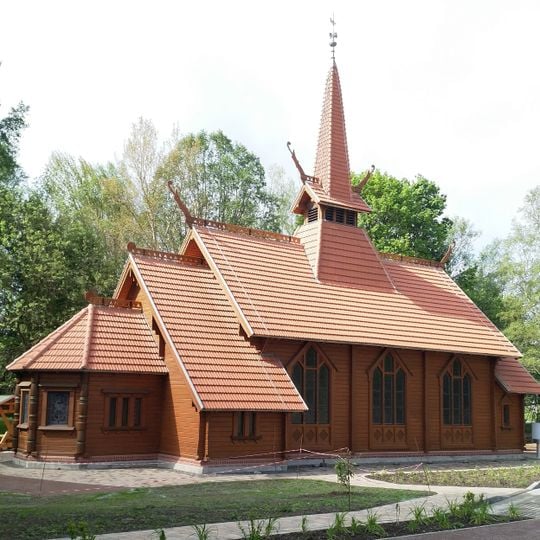
Stabkirche Stiege, Norwegian-style wooden church in Stiege, Germany
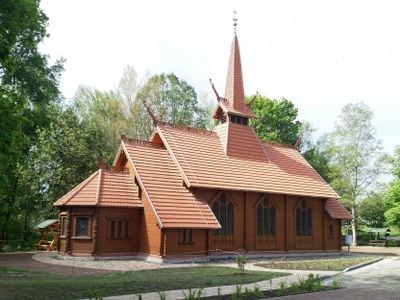
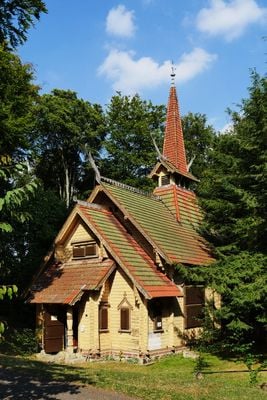
Stabkirche Stiege is a wooden church of 1905, 23 metres long, eleven metres wide and nine metres high without a tower, with 110 seats. It is built in horizontal block construction, not true stave work, and its interior frame uses no nails or screws. A slender square tower with a shingled spire and cross rises from the steep roof; the walls are reddish-brown planks on a low stone base, with tall arched windows in pairs and triplets.
Built in 1905 beside the Albrechtshaus lung sanatorium, the church was consecrated on 20 May 1905 with Prince Regent Albrecht of Prussia present; tradition holds that a cured Scandinavian patient donated it. It stood in the Selke valley for over 116 years, was closed in 2011 after vandalism, and was moved in 2021–22 to a site near Stiege station, reopening on 20 May 2022.
The church is not a true stave church: it was built in 1905 in horizontal log construction, modelled on the stave church of Wang in the Riesengebirge. Its stained-glass windows came from Ferdinand Müller's workshop in Quedlinburg. A tradition holds that a grateful Scandinavian patient cured of tuberculosis at the Albrechtshaus sanatorium donated the building.
The building stands directly next to Stiege railway station and can be reached by car or via the Selketalbahn steam train. Visitors should check local opening times and follow the main entrance, which is easy to locate.
The church is not a true stave church: it was built in 1905 in horizontal log construction, modelled on the stave church of Wang in the Riesengebirge. Its design came from master carpenter R. Witte of Osterwieck, and the stained-glass windows from Ferdinand Müller in Quedlinburg. Tradition holds that a grateful Scandinavian patient cured of tuberculosis at the Albrechtshaus sanatorium donated it.
The community of curious travelers
AroundUs brings together thousands of curated places, local tips, and hidden gems, enriched daily by 93,900 contributors worldwide.