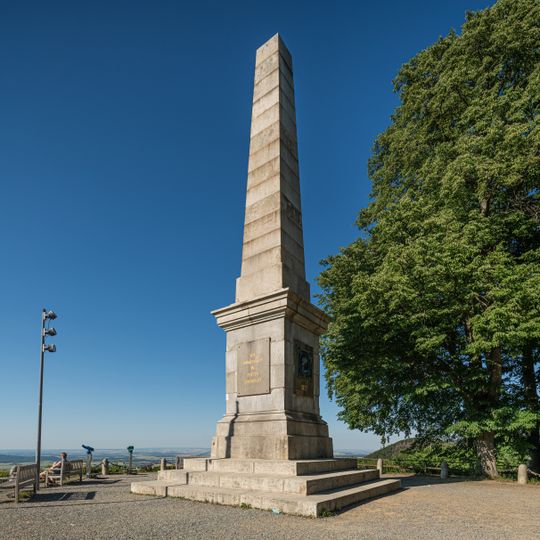
Canossasäule, Memorial obelisk in Bad Harzburg, Germany.
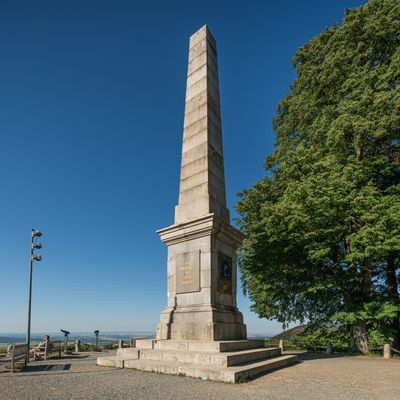
The Canossasäule is a 19-metre obelisk of unadorned, upward-tapering stone blocks on a tall pedestal crowned by a wide cornice, itself set on a three-stepped square stairway. The front of the pedestal carries a bronze plaque with a laurel-wreathed profile of Otto von Bismarck and the year 1877; the rear bears a stone tablet with the inscription "NACH CANOSSA GEHEN WIR NICHT — REICHSTAGSSITZUNG 14 MAI 1872".
The monument was erected in 1877 and honors Bismarck's declaration that Germany would not submit to papal authority. This statement referred to a major political struggle between the German state and the church during that era.
The monument displays a bronze medallion with Bismarck's profile and carries inscriptions that recall the conflict between secular and religious power. These symbols tell of an important moment when Germany wanted to assert its political independence.
The monument stands on Großer Burgberg at roughly 482 meters elevation and offers visitors views over Bad Harzburg. The site is easily accessible, and the illuminated structure can be visited in the evening hours as well.
The two Valkyrie figures flanking the obelisk, added by sculptor Wilhelm Engelhard in 1883, had already weathered away before World War I and were removed. The monument's rear stone tablet quotes the Reichstag session of 14 May 1872: "Nach Canossa gehen wir nicht."
The community of curious travelers
AroundUs brings together thousands of curated places, local tips, and hidden gems, enriched daily by 92,657 contributors worldwide.