Schandauer Schlossberg
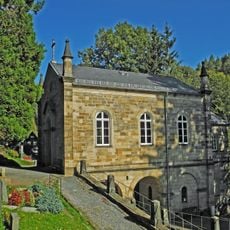
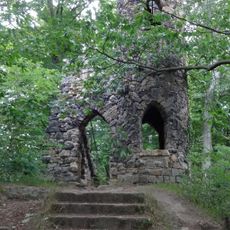
Schandauer Schlossberg is a hill spur in Bad Schandau holding the earthworks of a 13th-century castle and, on the same plateau, the artificial ruin inaugurated on 24 June 1883. The castle plateau forms an irregular quadrilateral of about 20 by 45 metres, enclosed by a double wall and ditch; the round cistern cut into the rock survives, now filled in. The ruin's tower has an external stone stair with metal railing and an internal spiral stair to a viewing platform.
The castle was probably built in the 13th century as a river and road watch to secure trade on the Elbe and the Via Regia. It belonged to the Berka von Dubá family at Hohnstein Castle and was likely destroyed during the Hussite Wars (1419–1434). In 1883 builder Dachsel erected an artificial ruin on the site, integrating remains of the original walls.
The name Schomberg, also recorded as Schoumberg on a 17th-century map by Merian, may derive from Middle High German schouwen (to look), pointing to use as a signal lookout. The hilltop is also called Kiefericht. The artificial ruin was named Frienstein at its 1883 inauguration, but the local group dropped that name in 1906 after the Vordere Raubschloss was identified as the real Frienstein.
The tower platform is reached by an outdoor stone stair secured with a metal railing, followed by a spiral staircase inside the tower. Trees around the platform limit the view to Bad Schandau and the Elbe valley. The plateau lies about 300 m north of Bad Schandau's centre, and the round cistern is filled in.
The 1883 ruin was named Frienstein at its inauguration by the Gebirgsverein für die Sächsische Schweiz; after the Vordere Raubschloss was identified as the real Frienstein, the local group dropped the name in 1906. The tower's platform is reached by an outside stone stair with metal railing and an inner spiral stair.
The community of curious travelers
AroundUs brings together thousands of curated places, local tips, and hidden gems, enriched daily by 93,974 contributors worldwide.