Stechinelli-Kapelle, Baroque chapel in Wieckenberg, Germany
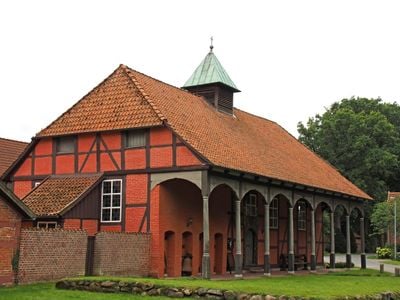
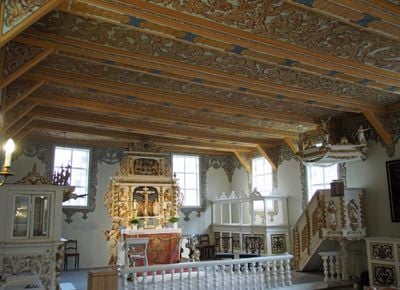
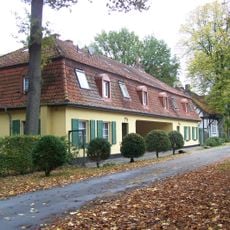
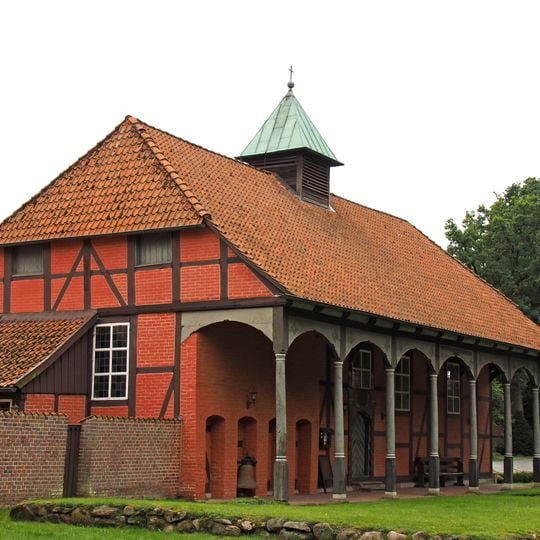
The Stechinelli-Kapelle in Wieckenberg is a red brick building with dark half-timbering on its upper facade under a steep roof of orange clay tiles, topped by a green-patinated square roof turret. A recessed open arcade with grey stone columns runs along one side. Inside, the wooden beamed ceiling is painted with dense ochre and blue foliate scrollwork, and a white and gold altar with a central crucifix stands above a red frontal.
The chapel was founded in 1692 by Francesco Maria Capellini as a private place of worship after receiving permission from Duke Georg Wilhelm. The duke required that the building resemble a farmhouse on the outside.
The chapel's name recalls Francesco Maria Capellini, called Stechinelli, whom Emperor Leopold I raised to hereditary imperial nobility in 1688 as "von Wickenburg". The altar retable carries the alliance coat of arms of Stechinelli and his second wife, with hat and rose. The painted wooden ceiling shows several children's heads, thought to depict Stechinelli's children.
The chapel stands in Wieckenberg, a district of Wietze in the Celle district, and is still used for Protestant worship. Since October 2008 it has been a station on the Jakobsweg Lüneburger Heide pilgrimage route, so walkers pass through. The building was restored in 1911, 1981/82, 2008 and most recently 2012/13; the interior reflects the 1981/82 reconstruction of the 18th-century painting.
The ceiling painting includes several children's heads, thought to depict Stechinelli's own children. The altar retable carries the alliance coat of arms of Stechinelli and his second wife, with the symbols of hat and rose. The first organ, built in 1971 by E. F. Walcker & Cie. with five stops, was replaced in 2020 by a new Italian-style instrument by Jörg Bente with six stops.
The community of curious travelers
AroundUs brings together thousands of curated places, local tips, and hidden gems, enriched daily by 92,680 contributors worldwide.