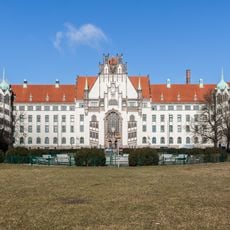
Luisenbad Library, Public library in Wedding and Gesundbrunnen, Germany.
Luisenbad Library occupies the former Marienbad complex between the Panke and Travemünder Straße in Gesundbrunnen. Two 19th-century buildings survive: the two-storey Vestibül of 1888 in Neorenaissance style, with a decorated gable wall and coloured brickwork, and the Z-shaped Comptoir, its façades patterned in red, yellow and white brick. Both were fitted with 1990s additions and linked underground; the book collection sits in a lower level lit by skylights, reached by a curved ramp and lift.
A healing spring was found on the site in 1760, and the name Luisenbad has been used since 1809. In 1874 Ernst Gustav Otto Oscholinski founded the Marienbad, a complex with a swimming pool, restaurant, café and beer garden. Carl Galuschki bought the land in 1885 and added the Vestibül in 1888. Bombing in 1945 destroyed the bathhouse; after protests against demolition in the late 1970s, the library opened in 1995.
The name Luisenbad has been used for the site since 1809, after the healing spring found there in 1760. The children's department grew out of the Jerusalem youth library at Nauener Platz, whose holdings moved here in the late 2000s. In summer the sculpture garden around the Vestibül serves as a reading garden.
The library sits between the Panke and Travemünder Straße, a step off the busy Badstraße, so it is easily overlooked from the street. The lower floor is reached by a curved ramp and a lift. The entrance is on the ground floor of the Vestibül.
The library is easy to miss: it sits set back from the busy Badstraße in a green space beside the Panke, so passers-by often overlook it. The two surviving 19th-century buildings, the Vestibül and the Z-shaped Comptoir, are linked underground rather than by a bridge, keeping the historic passage between them open.
The community of curious travelers
AroundUs brings together thousands of curated places, local tips, and hidden gems, enriched daily by 92,637 contributors worldwide.