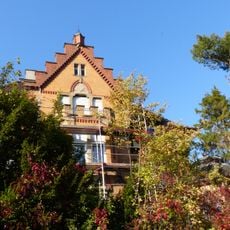
Martinskirche, Gothic church in Kornwestheim, Germany.
Martinskirche is a Gothic church in Kornwestheim whose nave, rebuilt in 1967–1968, measures 22 by 11.7 metres and keeps its 13th-century north wall; the south wall was moved 2.5 metres south. The Gothic choir (13 by 8.5 metres) with its net vault and five painted keystones is unchanged, and the whole building is 35.5 metres long.
Excavations in 1967 under Barbara Scholkmann traced a wooden church of around 630/640, built over a masonry grave of a Merovingian nobleman. A stone hall replaced it in the mid-8th century, and around 1100 a larger hall church was built under the patronage of Hirsau Abbey, whose donation charter holds the first written mention of the church. After a fire, a new church with a choir tower followed in the late 13th century; the nave was renewed between 1481 and 1495 under pastor Jakob Böhmler. From the late 15th century to 1516, master builder Hans von Ulm planned a complete rebuild, but only the choir and its side tower were realised, probably for lack of money; the Peasants' War of 1525 and the Reformation in Württemberg of 1534, which dissolved Bebenhausen Abbey, ended the project. Since then the church has been Protestant.
The church is also called the "old village church" to distinguish it from Kornwestheim's Catholic St. Martinuskirche, founded in the early 20th century. On the north side stand the former tithe barn of 1573, converted in 1979/1980 into the Philipp-Matthäus-Hahn parish house, and a Luther oak planted in 1883.
The church stands on the Dorfplatz in the old village centre north of Kornwestheim's centre, beside the former Zehntscheuer of 1573 and the Luther Oak planted in 1883. The main entrance with its stair to the west gallery is on the south-west side. The interior seats about 400 people.
The south wall of the nave was moved 2.5 metres south in 1967–1968, a shift already planned around 1500; the binder stones at the southwest corner of the choir still mark the intended line. The Gothic crucifix on the south wall, carved around 1480, likely survives from the previous church.
The community of curious travelers
AroundUs brings together thousands of curated places, local tips, and hidden gems, enriched daily by 93,661 contributors worldwide.