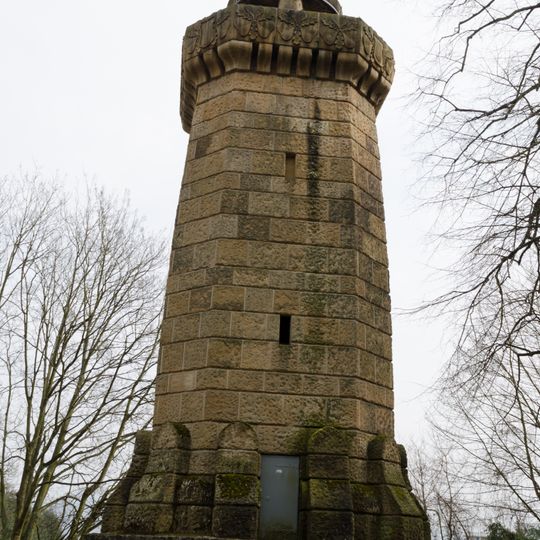
Bismarck Tower, Observation tower in Bad Godesberg, Germany.
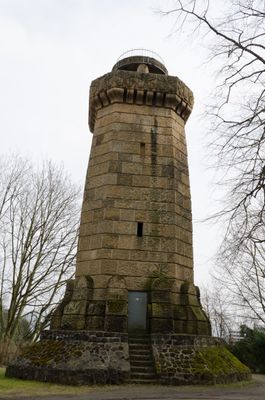
The Bismarck Tower in Bad Godesberg is a 20.4-metre-high monument on an octagonal ground plan, built from coarse-grained brown-yellow sandstone, with a roughly two-metre-high base of basalt lava. Twelve buttress walls, each 2.60 metres high, lean against the shaft at ground-floor level. Steps set into the west side of the base lead to the entrance and an internal stone spiral staircase of 60 steps.
A committee founded in Godesberg in 1899, chaired by Geheimen Medizinalrat Brandis and including mayor Anton Dengler, chose the Wacholderhöhe as the site. Berlin architect Ernst Spindler designed the tower, built in 1901/02 by the Godesberg firm Theodor Wilhelm Düren with donated funds of 21,000 Mark. It was inaugurated on 31 March 1902 with a festive procession from the Kurpark and the first fire lit on top.
The tower is named after the Prussian statesman and serves as a local landmark that residents and visitors recognize from different parts of the city. It functions as a meeting point and reference marker for people exploring the area.
The tower stands on the Wacholderhöhe at Elisabethstraße in Alt-Godesberg, and access has been closed to unauthorised persons since 1956 for safety reasons. The interior stone spiral staircase of 60 steps and the metal ladder to the platform are therefore not open to visitors. The structure can be viewed from the outside.
The structure was originally equipped with a beacon light that was meant to be part of a planned network of illuminated monuments across the country. Though this lighting function has long since disappeared, the tower still reflects those ambitious plans from the imperial era.
The community of curious travelers
AroundUs brings together thousands of curated places, local tips, and hidden gems, enriched daily by 93,136 contributors worldwide.