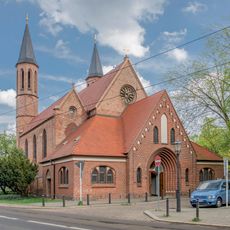
Amalienpark, Urban park in Pankow, Germany
Amalienpark is a 3,000 m² residential park in Berlin-Pankow between Wolfshagener and Breite Straße. It consists of a green space and surrounding buildings: nine detached two- to three-storey houses in Landhaus style, grouped around the park and accessed by a private two-lane road. The complex was designed by Otto March in 1897; one building (Amalienpark 4/5) was partly destroyed in World War II.
The park was designed in 1897 by architect Otto March during a time when Berlin was expanding its green spaces for its growing population. It was part of a broader effort to provide recreational areas for city residents.
The park shows how Berliners around 1900 spent their leisure time, with pathways and open spaces designed for walking and gathering. The layout still invites visitors to move through the greenery at their own pace.
The park is accessible by public transportation and has benches distributed throughout for resting. Wearing comfortable shoes is recommended as the pathways invite exploration.
The Amalienpark was rebuilt by the Cajewitz-Stiftung from 1990, and after ten years the original state of the ensemble was restored. The sandstone sculpture Maske der Medea by Christine Dewerny was re-erected in 1996, next to the Sitzendes Liebespaar by Carin Kreuzberg, installed in 1976.
The community of curious travelers
AroundUs brings together thousands of curated places, local tips, and hidden gems, enriched daily by 92,660 contributors worldwide.