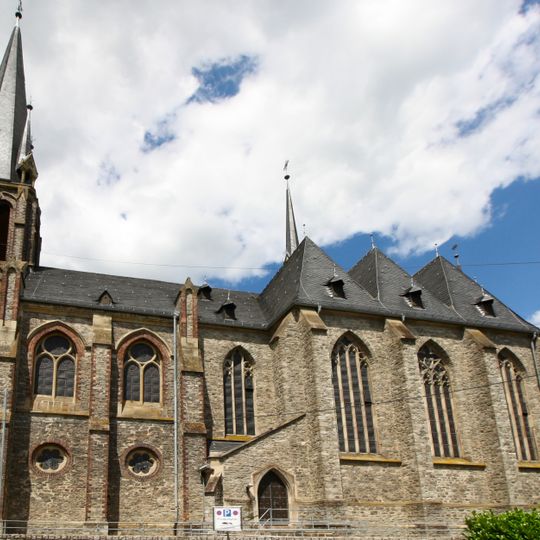
Westerwälder Dom, Catholic church building in Wirges, Germany.
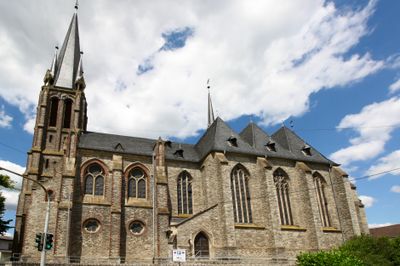
St. Bonifatius, known as the Westerwälder Dom, is a Catholic church in Wirges built in Gothic revival style from 1885 to 1887 to a design by Frankfurt architect Max Meckel. The photograph shows rough grey-brown stone walls with lighter trim, tall pointed-arch windows with tracery in pairs, small round windows below them, and a pointed-arch wooden door. The building has a steep slate roof with a tall spired tower on the left and a shorter spire mid-roof.
A first stone church stood here around 1200; its Romanesque tower was kept when a late-Baroque nave was added in 1774. The present Gothic Revival church was built in 1885–1887 to plans by Max Meckel and consecrated on 20 August 1887 by Bishop Karl Klein. Since 1902 the building has been popularly called the "Westerwälder Dom".
Locals call St. Bonifatius the "Westerwälder Dom", a nickname in use since 1902. The parish is dedicated to Saint Boniface, and the church is the third building on the site to bear his name, replacing predecessors that the growing congregation had outgrown.
The main entrance is the pointed-arch wooden door at the base of the facade; a sign beside it marks a parking space and wheelchair access. The church stands in the centre of Wirges, on the site of its two predecessors, so it is reached on foot from the surrounding streets. Visitors should time a look around the nave outside service times.
The nickname "Westerwälder Dom" (Westerwald Cathedral) has been used in popular speech since 1902, although the church is only a parish church. The foundation stone of the previous late-baroque church, demolished around 1885, is still visible today next to the side entrance toward the rectory.
The community of curious travelers
AroundUs brings together thousands of curated places, local tips, and hidden gems, enriched daily by 93,147 contributors worldwide.