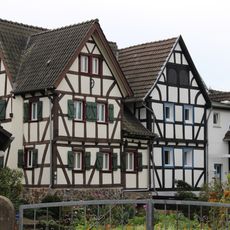
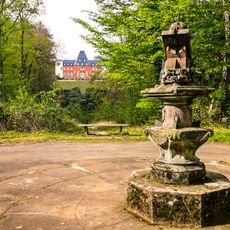
Gut Ettenhausen, Architectural heritage monument in Beuel, Germany.
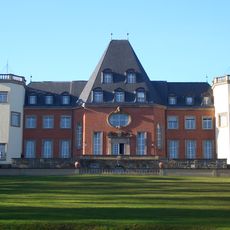
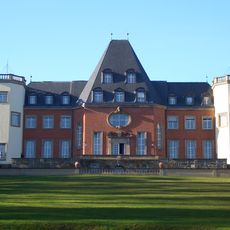
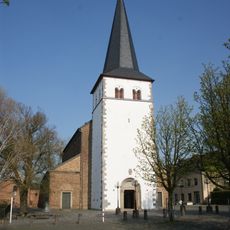
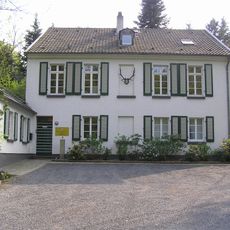
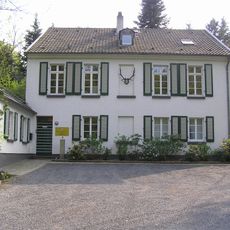
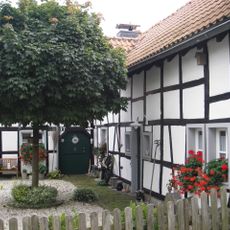
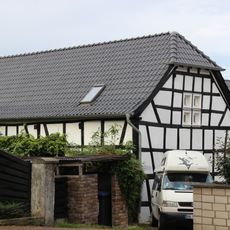
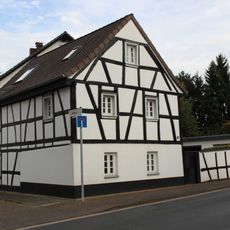
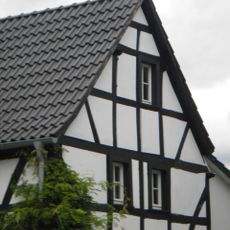
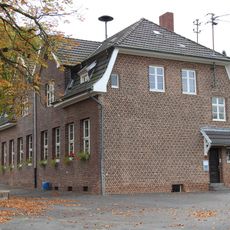
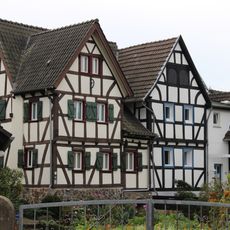
Gut Ettenhausen is an estate in Beuel with buildings that display traditional regional forms and developed over several centuries. The property includes a main house alongside several outbuildings that reflect the daily workings of an agricultural complex.
Ettenhausen was first recorded in the late 14th century as the property of Dietrich von Markelsbach, with tithes paid to the Bonn Cassiusstift. In 1423 Heinrich Vroymerliff, a Cistercian monk of Heisterbach Abbey, brought the farm into the abbey's possession and it was leased out. The Lichtenberg tenants bought it in 1821; around 1900 Moritz Rumler had the three farms demolished and built a new estate, and in 1936 Albert Ernst Broschek added new farm buildings and a two-storey house.
The name Ettenhausen appears in 14th-century records as Ettenhusen or Ettenhuysen. A wooden beam walled into a later building carries an inscription; the estate's 1803 extent was 94 Morgen of arable land and 234 Morgen of meadow and forest. Since 1994 the Apel family has owned the farm and its roughly 60 hectares.
The estate stands at Ettenhausener Straße 91 in Hoholz, part of Bonn's Beuel district on the right bank of the Rhine. It operates as a riding centre, so riders book lessons and livery on their own horses; non-riders should arrange a visit in advance. Two stone wayside crosses stand on the grounds, one opposite the farm entrance.
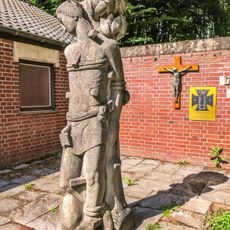
Two stone wayside crosses stand on the grounds: the listed Richarzkreuz from the late 19th century faces the farm entrance across the road, and a second 19th-century cross was set into a side wall of the 1936 manor house. A wooden beam bearing the inscription 1803 is walled into a later building.
The community of curious travelers
AroundUs brings together thousands of curated places, local tips, and hidden gems, enriched daily by 94,279 contributors worldwide.