Märkische Ölmühle, Industrial heritage monument in Wittenberge, Germany.
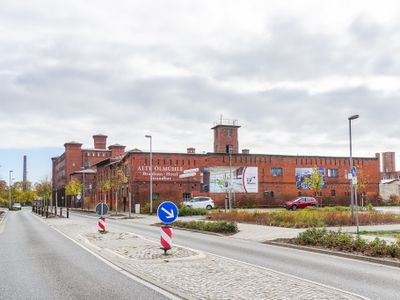
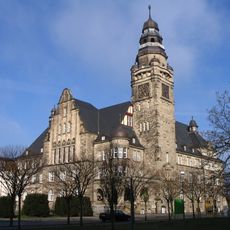
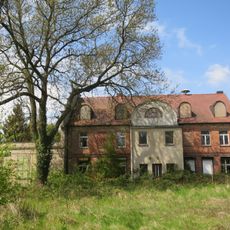
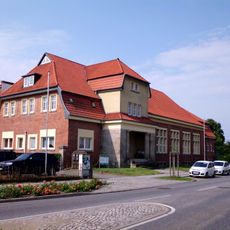
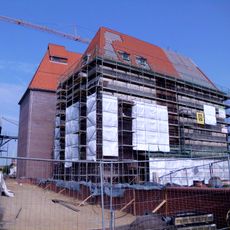
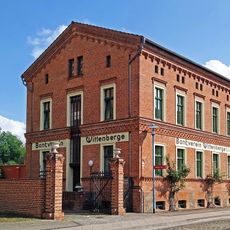
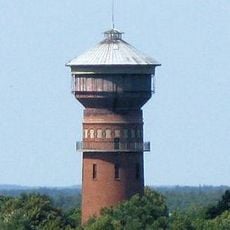
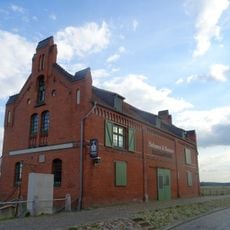
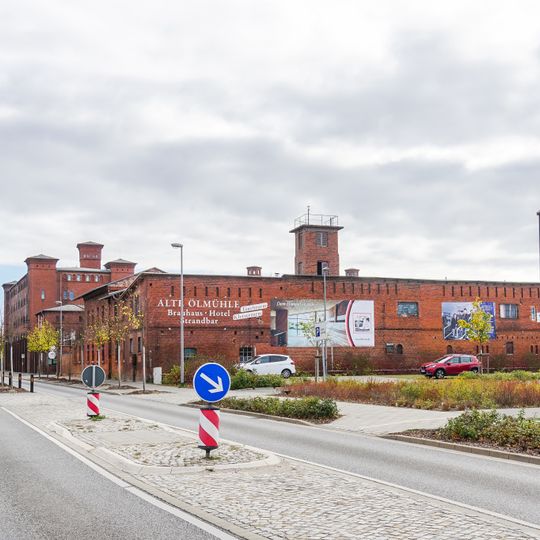
Märkische Ölmühle is a brick industrial complex on the Elbe in Wittenberge, built from the mid-19th century for oil production. It comprises an administrative building, the mill body, workshops and a storage building, four to five storeys high, with round-arched windows and doors and corner towers. The four-storey tower dominating the bank served as the suction tower for loading and unloading oil onto ships.
Salomon Herz, a merchant from Berlin, bought land on the Elbe in Wittenberge in 1823 and built an oil mill there, the basis of his oil trading company. A major fire destroyed most of the buildings in 1856, but they were rebuilt and steadily expanded. In 1873 the Herz family funded 16 rent-free flats for old and disabled workers and a municipal orphanage. The plant became the S. Herz Ölfabriken AG in 1929 and, as VEB Märkische Ölwerke, employed about 700 people by 1968; production ended in 1991.
The industrial complex displays preserved original features like wooden beams and period doors that show how workers moved through the space during production days. These architectural details give visitors a sense of the building's working past and the craftsmanship involved in its construction.
The site is located on Bad Wilsnacker Street 52 in Wittenberge and functions today as a hotel with dining and wellness facilities open to visitors. Its position on the Elbe makes it easy to find and provides a good base for exploring the city's industrial heritage.
The canal that fed the mill's water wheels was named Herzscher Kanal after founder Salomon Herz. It was filled in again in 1938/1939, when electric power had replaced water power. The street to the works was called Herzstraße from 1898 until the 1990s, now Bad Wilsnacker Straße.
The community of curious travelers
AroundUs brings together thousands of curated places, local tips, and hidden gems, enriched daily by 92,637 contributors worldwide.