Schloss Schönhausen I, Bismarck's birthplace palace in Schönhausen (Elbe), Saxony-Anhalt, Germany
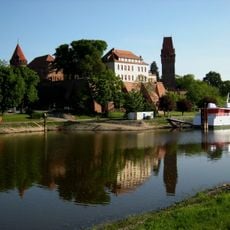
Schloss Schönhausen, also called Schönhausen I, stands in Schönhausen (Elbe) in the Altmark, northwest of the village. Of the manor house built around 1700, only one side wing survives, used since 1998 as the Bismarck Museum. Its left part shows a weathered red brick wall with arched recesses and a rough grey plastered base; the right part has a white plastered facade with a red tiled roof, white-framed windows partly overgrown with green vines, and grey stone steps leading to a dark wooden door framed by a small round tower with a conical red tiled roof. A brick chimney sits on the roof ridge, and the baroque Bismarckpark borders the site.
Schönhausen I passed to the von Bismarck family on 7 December 1562, when they took over the Bardeleben estate, and the Möllenbeck estate was added on 1 March 1563. The present Schloss was built around 1700, attributed to Rittmeister Karl Alexander von Bismarck-Schönhausen (1727–1797). In 1945 the family was expropriated, and in 1958 the GDR authorities blew up the Schloss except for one side wing, which has housed the Bismarck Museum since 1998.
The palace is also called Schönhausen I to distinguish it from the neighbouring estate Schönhausen II. Since 1998 the surviving side wing has housed a Bismarck Museum, and the baroque Bismarckpark adjoins the former palace grounds. The village of Schönhausen (Elbe) in the Altmark is its setting, not Berlin.
Schloss Schönhausen I lies in the northwest of Schönhausen (Elbe) in the Altmark, not in Berlin. Only a side wing survives, and since 1998 it has housed the Bismarck Museum. The baroque Bismarckpark borders the former palace grounds, so a visit can be combined with a walk there.
The three chimneys on the roof were likened in local speech to the three hairs with which Bismarck was caricatured in the satirical journal Kladderadatsch, a nod to the Grimms' tale The Devil with the Three Golden Hairs. Only a side wing survives; the main building was blown up in 1958 by order of the GDR authorities.
The community of curious travelers
AroundUs brings together thousands of curated places, local tips, and hidden gems, enriched daily by 92,657 contributors worldwide.