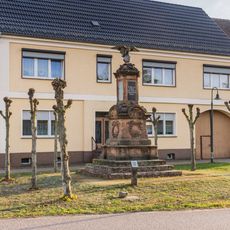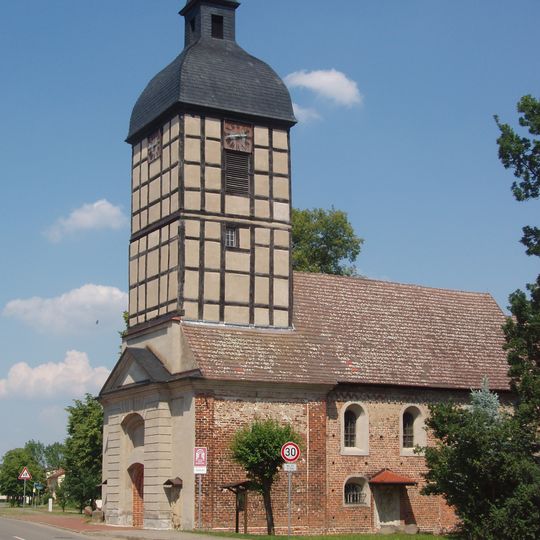
Dorfkirche Wust, Medieval church in Wust, Germany
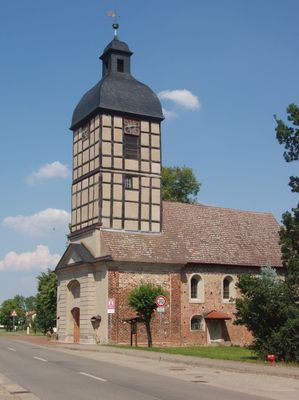
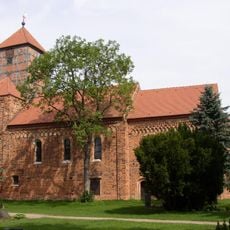
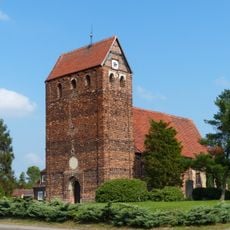
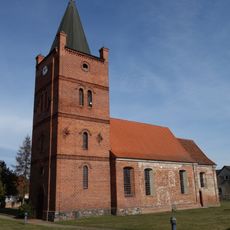
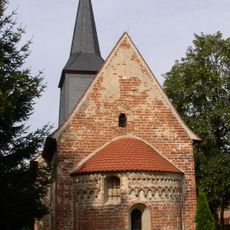
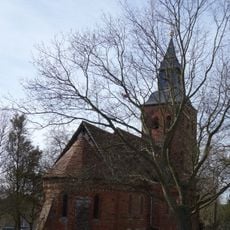
Dorfkirche Wust is a flat-roofed Romanesque brick church with a nave, a recessed square choir and a semicircular apse, decorated with corner pilasters and angular friezes. Its Baroque tower has a massive base the width of the nave and a two-storey timber-framed upper section of 1727 with a curved hood. A Baroque burial chapel of the von Katte family of 1708 adjoins the apse to the east.
Consecrated between 1191 and 1206 by Bishop Helmbert of Havelberg, the brick church was built under the influence of Jerichow Monastery. The Baroque tower received its two-storey timber-framed upper section in 1727. After decades of decay from about 1930, the small congregation and villagers restored the building between 1978 and 1981.
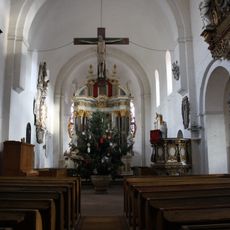
The village church is a station on the Straße der Romanik, the Romanesque Road linking medieval brick churches in Saxony-Anhalt. Its interior was furnished by Hans von Katte (died 1684): a coffered ceiling with painted angel putti and rosettes, a horseshoe gallery with angel heads, and a pulpit altar with a pulpit clock. The organ front dates from 1756.
The church stands in the village of Wust, part of Wust-Fischbeck in the Stendal district, and is one of the stops on the Straße der Romanik (Romanesque Road) through Saxony-Anhalt. The tower's massive base and the nave sit close to the village lane, where a 30 km/h sign marks the traffic calming. The building is a heritage monument and an active parish church, so visits depend on the congregation rather than fixed opening hours.
East of the apse stands the Baroque burial chapel of the von Katte family, built in 1708, not beneath the floor. Lieutenant Hans Hermann von Katte, beheaded in 1730, is buried here; Theodor Fontane later wrote about his death and the tomb in his Wanderings through the Mark Brandenburg.
The community of curious travelers
AroundUs brings together thousands of curated places, local tips, and hidden gems, enriched daily by 93,763 contributors worldwide.