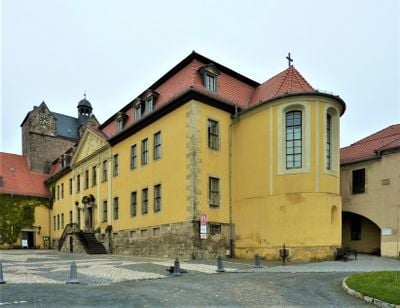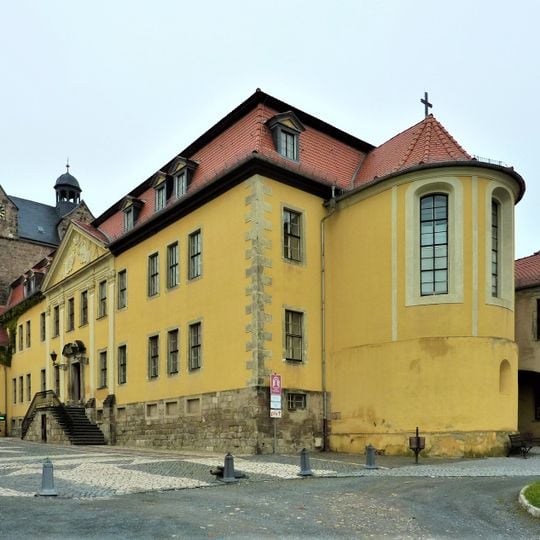
Schloss Ballenstedt, Baroque castle in Ballenstedt, Germany.
Schloss Ballenstedt is a baroque castle with three wings standing on a hilltop at the western edge of the town. The prominent north wing incorporates remains of a former monastery church, and the complex functions today as both a museum and cultural venue.
The castle originated in the early 18th century through the conversion of a medieval monastery complex into a baroque residence for the Princes of Anhalt-Bernburg. This transformation marked the shift from religious to princely use of the site.
The south wing's permanent exhibition "Höfisches Wohnen", curated by Carl Ludwig Fuchs and opened in 2018, reconstructs the living quarters of the Ascanian family between 1860 and 1945 in eight rooms, among them a music room, study, bedroom, ballroom and the Roman Room, whose canvas wall coverings by Berlin painter Johann Fischer show Roman ruin scenes after Piranesi. A small display is also devoted to wood artist Werner Müller of Stecklenberg.
The castle stands on a hill at the western end of Ballenstedt, with the former Jagdzeughaus (now the Großer Gasthof hotel), the Schlosstheater, the Marstall (now a café and senior residence) and the 52-hectare Schlosspark all part of the ensemble. The grounds and park paths are partly uneven, so sturdy footwear helps.
The tomb of Albrecht the Bear and his wife Sophie survives in the western end of the two-storey north wing, in the remains of the westwork of the former monastery church — not in a basement. Albrecht, the first Ascanian Margrave of Brandenburg, probably had his main residence at the castle until about 1140/45.
The community of curious travelers
AroundUs brings together thousands of curated places, local tips, and hidden gems, enriched daily by 93,071 contributors worldwide.