Ibn Rushd-Goethe mosque, Liberal mosque in Moabit, Germany.
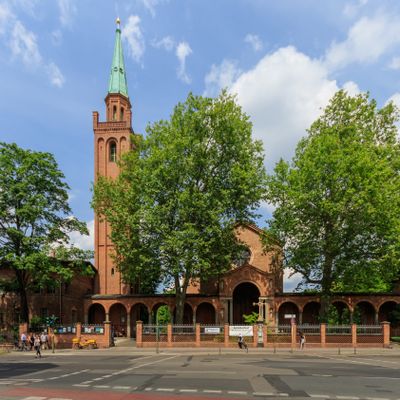
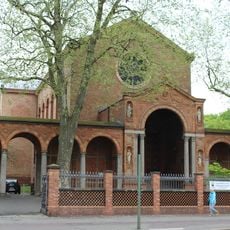
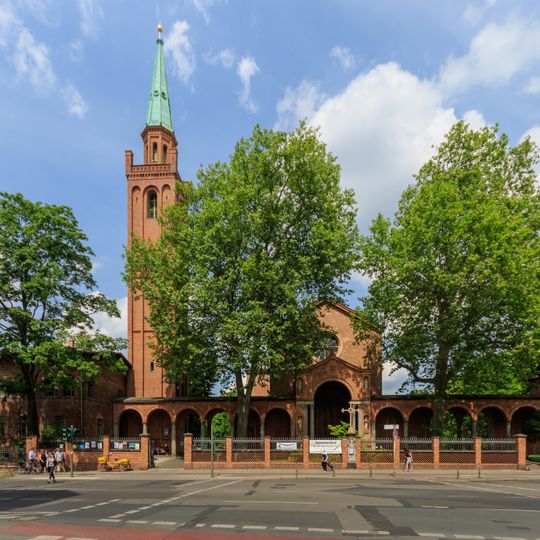
The Ibn Rushd-Goethe Mosque is a mosque in Berlin's Moabit district that met until October 2020 in a side building of the Protestant St. Johannis church. The photograph shows a red brick building with a square tower, narrow arched windows, a green copper spire with a gold tip, and a ground-level arcade of pointed arches. A low wall with a metal fence encloses the courtyard; signs read "Johanniter" and "Kirchengemeinde".
The mosque was founded in 2017 by lawyer Seyran Ateş to create a reform-oriented Islamic place of worship. Its opening triggered criticism from conservative religious authorities in several countries who rejected its interpretation of Islam.
The mosque is open to Sunni, Shia, Alevi and Sufi Muslims, and women and men pray together in the same room. Since 2021 it has run Muslim pastoral care for LGBTQI+ people under the banner "Liebe ist halal". Its name honours Ibn Rushd (1126–1198) and Goethe (1749–1832).
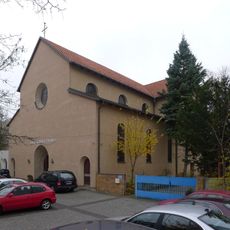
The mosque met in a side building of the Protestant St. Johannis church until October 2020, then moved to another building in Moabit. Full-face veils such as burqas and niqabs are not admitted, for security reasons and because the community does not regard them as religious. Women are not obliged to wear a headscarf. The mosque was closed from late October 2023 after warnings of an Islamist attack plot and reopened in 2025.
The mosque is named after Ibn Rushd (Averroes, 1126–1198), the Andalusian physician and philosopher known for his commentaries on Aristotle, and Johann Wolfgang von Goethe (1749–1832), whose West-östlicher Divan engages with Islam. In July 2022 it became the first mosque in Germany to raise a rainbow flag.
The community of curious travelers
AroundUs brings together thousands of curated places, local tips, and hidden gems, enriched daily by 92,648 contributors worldwide.