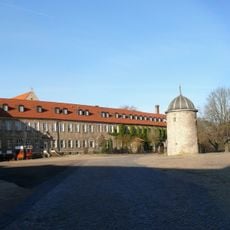
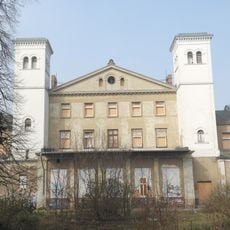
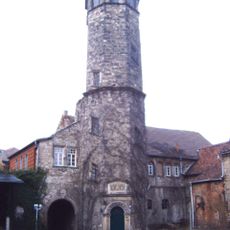
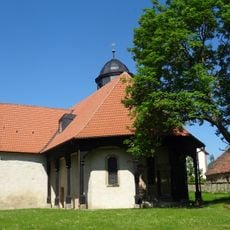
Schloss Peseckendorf, Château in Oschersleben, Germany.
Schloss Peseckendorf is a neo-Baroque manor house built from 1905 to 1912 by architect Paul Schultze-Naumburg for landowner Friedrich Schaeper, between the site of the old castle and the village. Its park side resembles Sanssouci; on the courtyard side a columned portal above the drive ramp carries Georg Kolbe's 1912 stone figures of the Four Seasons, now in the Börde-Museum Burg Ummendorf. The landscaped park with ponds lies on four hills, and a 25-metre tower first served as a lookout, then as a water tower.
In 1617, Busso von der Asseburg transformed an existing manor house into a Renaissance castle by adding strong fortifications and moats for defense. This redesign reflected the period's demand for both protective architecture and a display of aristocratic status.
The nickname "Sanssouci of the Börde" comes from the park front of the 1905–1912 house, modelled on Potsdam's Sanssouci. The sandstone figures "Four Seasons" that Georg Kolbe carved in 1912 for the portal above the drive were removed after 1945 and are now in the Börde-Museum at Burg Ummendorf. The building has stood for sale for years without a buyer.
Schloss Peseckendorf is for sale and has no regular opening hours, so visits should be arranged in advance with the owner or the town of Oschersleben. The landscaped park with its ponds and the four hills of the old castle site can be seen from public paths; most of the farm buildings were demolished after 1991, so do not count on shelter or facilities on site.
The park layout mirrors the design of Schloss Sanssouci in Potsdam, earning the location the local nickname 'Sanssouci of the Börde'. Recognizing this connection requires some knowledge, but it reveals how the owners wanted to incorporate European design trends into their residence.
The community of curious travelers
AroundUs brings together thousands of curated places, local tips, and hidden gems, enriched daily by 93,152 contributors worldwide.