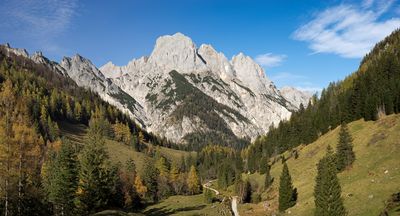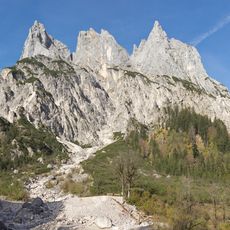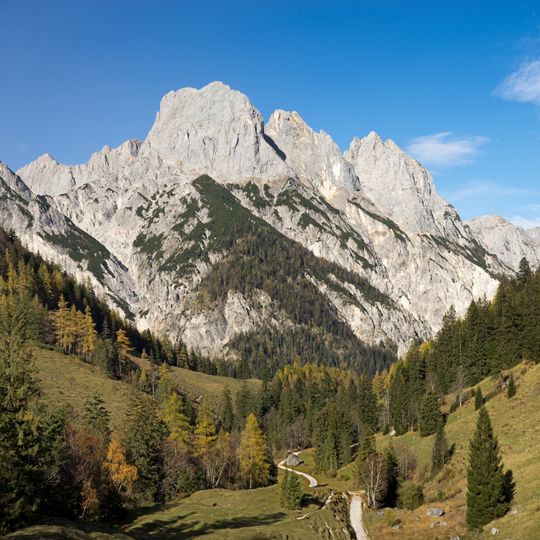
Bindalm, Architectural heritage site in Ramsau bei Berchtesgaden, Germany.
Bindalm is an alpine pasture in the Forst Hintersee district of Ramsau bei Berchtesgaden, at about 1120 m southwest below the Hocheiskopf. Three of its huts are listed monuments: the Baldramkaser, a single-storey log building with a fieldstone base and a shallow gable roof of leg shingles; the Kressenkaser, also a log building with a ridge purlin dated 1906; and the Schiedkaser, built around 1686 and moved here from the Feldalm in 1980. A narrow dirt path winds uphill past a small stone building with a pale curved roof, partly hidden by conifers.
The settlement developed as a summer pasture area where valley farmers brought livestock to graze at higher elevations during warmer months. This practice shaped the place from medieval times and established its character as a working alpine community.
The alm is still worked: cattle graze here in summer and the huts are staffed from early June. Three of its Kaser are protected monuments, including the Schiedkaser, built around 1686 and moved here in 1980 from the Feldalm. The Baldramkaser's Kasstöckl carries the year 1686, while the Kressenkaser's ridge purlin is marked 1906.
Bindalm sits at about 1120 m above sea level near the Hirschbichlstraße, just below the Hocheiskopf and close to the Hirschbichl inn on Austrian territory. It can be reached on foot, by mountain bike or with the Almerlebnisbus from the car park at Hintersee. The alpine huts are staffed from early June through the summer months.
Three of the alm's huts are listed monuments: the Baldramkaser, the Kressenkaser and the Schiedkaser. The Schiedkaser was built around 1686 and was moved here in 1980 from the Feldalm, so its timber frame stands on a site it did not originally occupy.
The community of curious travelers
AroundUs brings together thousands of curated places, local tips, and hidden gems, enriched daily by 92,763 contributors worldwide.