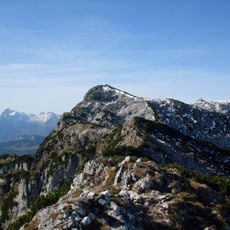
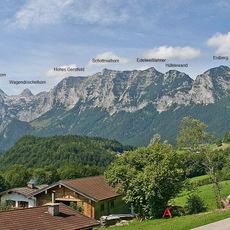
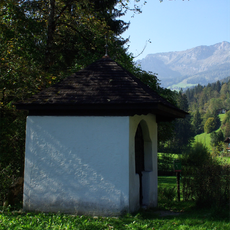
Mühlsturzhörner, mountain summits in the Berchtesgaden Alps, Bavaria, Germany
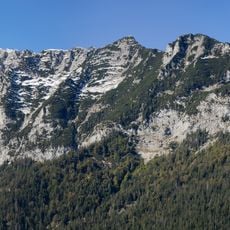
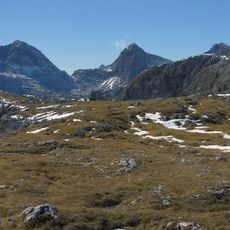
Mühlsturzhörner are two peaks in the Berchtesgaden Alps reaching 2,234 and 2,141 meters above sea level. These summits form part of the Reiter Alm massif and feature multiple climbing routes for different skill levels.
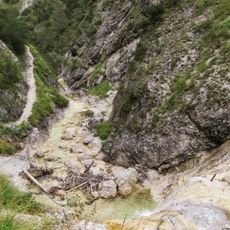
The first recorded climbs of the south edges date from the 1930s: the Alte Südkante was first ascended in 1930 by Huber and Mitterer, and the Direkte Südkante in 1936 by Anderl Hinterstoißer and Toni Kurz shortly before Kurz died on the Eiger north face. On 8 September 1999, 250,000 m³ of rock broke off the summit area of the Kleines Mühlsturzhorn and fell into the Klausbach valley.
The south faces carry named climbing routes: the Alte Südkante (grade VII−), first climbed in 1930 by Huber and Mitterer, and the Direkte Südkante (VI/A1 or VIII−), first climbed in 1936 by Anderl Hinterstoißer and Toni Kurz shortly before Kurz died on the Eiger north face.
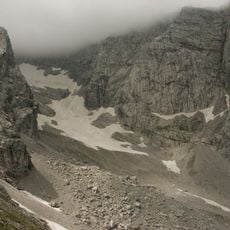
The unmarked normal route to the Große Mühlsturzhorn starts from the northwest, crossing the Mayrbergscharte gap and the Stadelhorn at UIAA grade II. Two further unmarked ascents exist: from the north through the Mühlsturzkar and up the south face, both grade II. The summits lie close to the Bavarian-Salzburg border, so tours can be combined with the Reiter Alm.
The Direkte Südkante on the Große Mühlsturzhorn was first climbed in 1936 by Anderl Hinterstoißer and Toni Kurz, shortly before Kurz died on the Eiger north face. The older Alte Südkante (grade VII−) had been opened in 1930 by Huber and Mitterer.
The community of curious travelers
AroundUs brings together thousands of curated places, local tips, and hidden gems, enriched daily by 92,850 contributors worldwide.