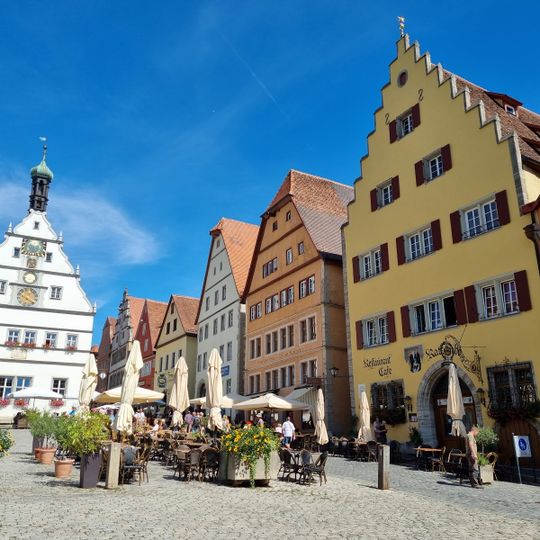
Town Hall, Gothic and Renaissance town hall in Rothenburg ob der Tauber, Germany.
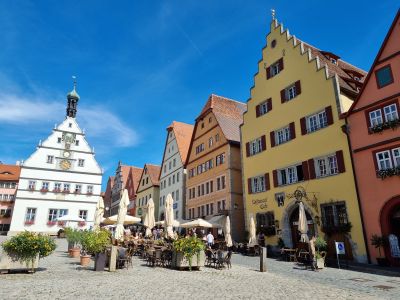
The town hall of Rothenburg ob der Tauber consists of two parallel three-storey blocks of ashlar masonry under steep saddleback roofs, separated by courtyards. An octagonal stair tower rises on the market-square side and an oriel sits at the south-east corner. The west gable carries a watchtower begun around 1200 and given its present form in 1555/58; a covered arcade was set in front of the market facade in 1681.
The building was first constructed as a Gothic structure around 1250 and received its distinctive appearance through a Renaissance extension added in 1572. It functioned as the administrative center during Rothenburg's centuries as a free imperial city, ending in the early 19th century.
Each evening a night watchman with a lantern appears by the town hall on the market square and walks his round while telling local legends. The building also carries a mechanical clock whose figures reenact the feat of Mayor Nusch, who in 1631 is said to have saved the town from Field Marshal Tilly's troops by draining a cup holding three and a quarter litres of wine in one go.
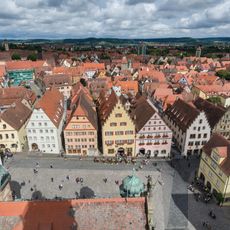
The viewing platform atop the roughly 61-metre tower is reached by a spiral staircase and is open from 9:30 to 12:30 and 13:00 to 17:00; from it you look over the town and the Tauber valley. The medieval dungeons in the town hall cellar can be visited from 09:00 to 18:00.
At the 1893 World's Columbian Exposition in Chicago, architect Karl Hoffacker modelled parts of the German House pavilion on the tower of Rothenburg's town hall. It was one of only four buildings kept standing after the fair closed.
The community of curious travelers
AroundUs brings together thousands of curated places, local tips, and hidden gems, enriched daily by 92,722 contributors worldwide.