Garnisonsmuseum, Military museum in Hohe Marter, Nuremberg, Germany
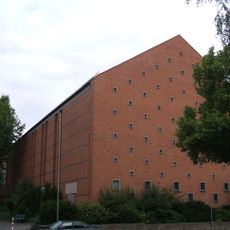
The Garnisonsmuseum occupies the Hohe Marter high-rise bunker, a seven-storey round building of reinforced concrete with brick facing and walls about 2.40 m thick, erected in 1941 as an air-raid shelter. Its flat cone roof, round-arched portal and arcade frieze are visible from outside. Inside, roughly 300 m² of exhibition space is arranged by period of Nuremberg's military history.
The seven-storey reinforced-concrete bunker with brick facing and walls about 2.40 m thick was built in 1941 as part of Nuremberg's air-raid protection programme. In 1992 a support association founded the garrison museum as a sub-museum of the Museum Industriekultur; in 1996 it moved into the bunker as an independent museum. The archive and library moved to the Spittlertorturm in 2006 for lack of space.
The museum displays uniforms, medals, and personal items from service members across different military periods. These collections help visitors understand how military life evolved over time.
The museum is housed in the seven-storey Hochbunker Hohe Marter, whose walls are about 2.40 m thick; the round building has a flat tent roof, a round-arched portal and an arcade frieze. Special guided tours of the museum and the city area are offered on request, including themes such as the Royal Bavarian Army and the US garrison. The archive and the specialist library with around 10,000 volumes were moved to the Spittlertorturm on the Nuremberg city wall in 2006 for reasons of space.
The building still has its original ventilation systems and reinforced doors from the bunker era. These technical details demonstrate how shelter structures were engineered against air raids.
The community of curious travelers
AroundUs brings together thousands of curated places, local tips, and hidden gems, enriched daily by 93,140 contributors worldwide.