Johanniskirche, Medieval church in Altstadt, Löbau, Germany.
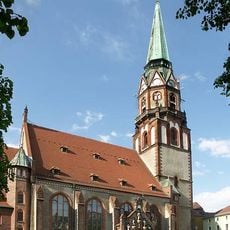
The Johanniskirche is a church building in Löbau's old town featuring stone walls and pointed arches characteristic of medieval design. The structure has a traditional church layout with a nave, Gothic-style windows, and a tower that rises above the surrounding rooftops.
The church was first mentioned in 1336, when a Franciscan monastery was founded in Löbau on the initiative of the citizens and the town. The convent adopted the Martinian Constitutions in 1504 and ceased to exist after the Reformation, being last mentioned in 1558. The church was restored after a fire in 1519, thoroughly renewed in 1666/1667 and rebuilt in 1840. From 1667 to 1956 it served the Protestant community, including Sorbian-language services until 1912.
The church is no longer a place of worship: it was deconsecrated and has belonged to the town of Löbau since 1994, which uses it as a cultural centre. Its Sorbian name, Janska cyrkej, recalls that services were held in Sorbian here until 1912, first weekly and from 1848 every two weeks, for villagers from Altlöbau, Oelsa and other villages belonging to Löbau.
The building is located in the center of the old town and is easy to reach on foot. Visitors can walk by at any time to view the exterior, while the interior is accessible at certain times or during community events.
Under the choir lies a crypt with a five-part ribbed vault, reachable only from outside the building. The tower attached to the south choir wall carries an octagonal bell storey crowned by eight wimpergs before a slender dome. The west portal bears the date 1840.
The community of curious travelers
AroundUs brings together thousands of curated places, local tips, and hidden gems, enriched daily by 94,453 contributors worldwide.