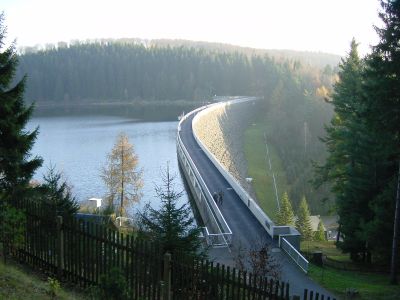
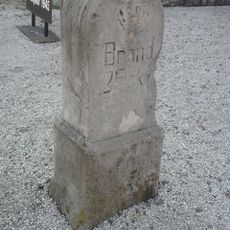
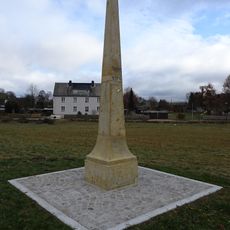
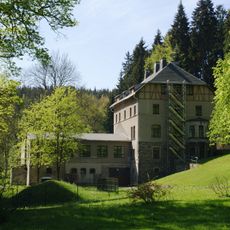
Saidenbach Dam, Drinking water dam in Pockau-Lengefeld, Saxony, Germany
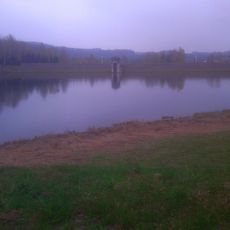
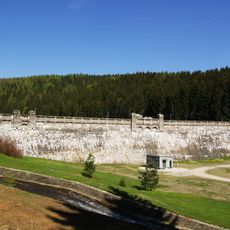
The Saidenbach Dam is a curved gravity dam of rubble stone masonry built on the Intze Principle, impounding the Haselbach, Saidenbach, Lippersdorfer Bach and Hölzelbergbach. It was built from 1929 to 1933 near Lengefeld in the Ore Mountains and supplies drinking water to Chemnitz and the South Saxony long-distance water association, with minor use for electricity and flood protection.
Construction of this dam began in 1929 as a response to growing demands for drinking water and electricity in the nearby Saxony region. Once completed, it became an important part of the local water and energy infrastructure that shaped the region's development.
The reservoir is a protected drinking-water source for Chemnitz, so swimming and water sports are banned; angling is allowed and a public path crosses the dam crest. The eastern shore exposes Saidenbachite rock, one of Germany's few diamond sites, where microscopic crystals sit inside garnets.
The area around the dam is accessible by car and has walking paths of varying difficulty for different visitors. The best time to visit is during warmer months when the trails are in good condition and the surroundings are green.
The rocks exposed on the eastern side of the reservoir are one of the few diamond sites in Germany: microscopic crystals occur inside garnets within saidenbachite, forming lens-shaped bodies in the gneiss. The bacterium Rhodoferax saidenbachensis was also isolated from the reservoir's sediment and named after the site.
The community of curious travelers
AroundUs brings together thousands of curated places, local tips, and hidden gems, enriched daily by 94,322 contributors worldwide.