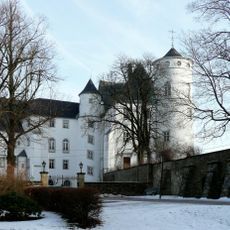
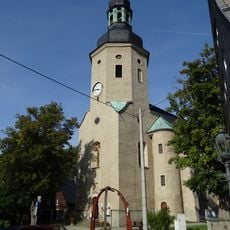
Schloss Lauenstein, Renaissance château in Lauenstein, Germany.
Schloss Lauenstein is an irregular castle complex on a steep, roughly triangular rocky spur above the Müglitztal. It consists of a large outer economic courtyard, a gatehouse with a sandstone round-arch portal and volute gable, and a baroque garden dated 1716. The oldest parts are 13th-century foundations, cellar vaults and the ruins around the Trompetersaal, which was demolished down to its north wall in 1849.
The oldest masonry, cellars and vaults date from the mid-13th century, when a fortress stood on the triangular spur above the Müglitz. Around 1480 the west wing and castle chapel were added; from the mid-16th century Günther von Bünau had the stronghold rebuilt as a richly decorated Renaissance palace. The Trompetersaal, built around 1600, was demolished down to its north wall in 1849.
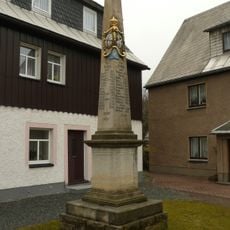
The museum is the Osterzgebirgsmuseum Schloss Lauenstein, named after the Ore Mountains range around the town. Its permanent displays cover the life and work of George Bähr, builder of the Dresden Frauenkirche, the castle's own building history, Saxon post mileposts and mail coaches, the Müglitztalbahn railway, and the nature of the Osterzgebirge. The Wappensaal can be booked for weddings.
The castle is open daily to visitors and easy to reach by car or public transport. You can explore all areas of the grounds, including rooms, gardens, and towers, on foot.
From April 1943 the most valuable holdings of the Hamburg State and University Library were stored in the castle's cellar vaults. In February 1946 parts were seized by the Red Army and taken to St Petersburg on 1 August 1946; a large share returned to Hamburg in May 1991.
The community of curious travelers
AroundUs brings together thousands of curated places, local tips, and hidden gems, enriched daily by 94,004 contributors worldwide.