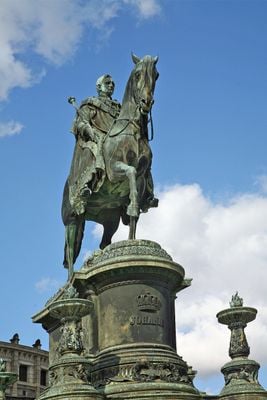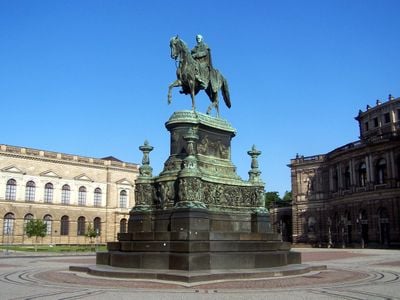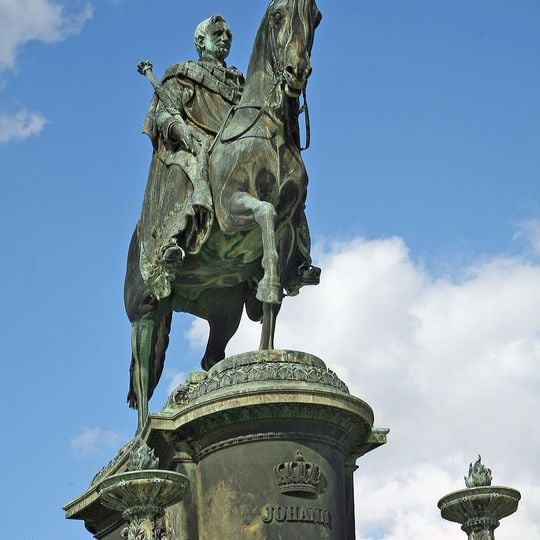
König-Johann memorial, Bronze equestrian statue in Theaterplatz, Dresden, Germany.
The König-Johann memorial is a bronze equestrian statue of King Johann of Saxony, six metres tall without its base and 13.5 metres with it, cast in 1889 by C. Albert Bierling from a model by Johannes Schilling. The king wears a coronation mantle and holds a sword hilt; the horse raises its right foreleg. The pedestal combines Lausitz granite and black-green microgabbro, with reliefs of mining, trade, shipping and the arts.
Johannes Schilling created this memorial in 1889 to honor King Johann of Saxony after his death in 1873. The monument was erected during a period when the region was reflecting on its past industrial growth and the king's role in it.
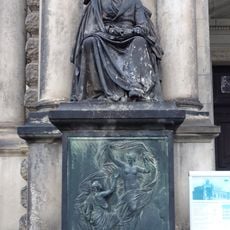
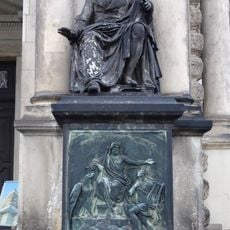
The pedestal reliefs carry an allegorical program: on the Zwinger side, Nature sits enthroned between cornucopias and a bull, flanked by wine-growing, sheep-rearing and harvesting; on the Elbe side, Mercury and Prosperity appear with mining, book trade, photography, a steam locomotive and a telegram-bearing messenger. The corner rounds pair Art, shown through its seven genres, with the military.
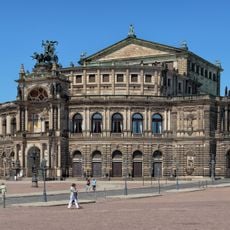
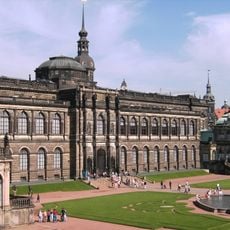
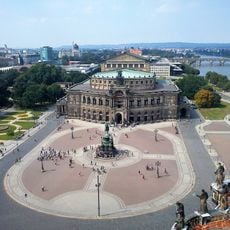
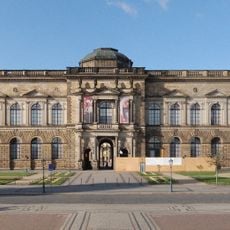
The memorial occupies the intersection of the central axes of the Semperoper and the Sempergalerie, so it is seen from both buildings' fronts. The square's uniform paving dates from the rebuilding of the opera house completed in 1878. The statue faces the opera; the reliefs on the Zwinger side and the Elbe side reward a walk around the base.
The pedestal reliefs carry a precise programme: on the Zwinger side, Nature sits enthroned between cornucopias and a bull, flanked by wine-growing, sheep-rearing and hunting; on the Elbe side, Mercury and Prosperity appear with mining, book trade and photography. The four rounded corners pair Art with the Military, and Science with Industry.
The community of curious travelers
AroundUs brings together thousands of curated places, local tips, and hidden gems, enriched daily by 94,111 contributors worldwide.