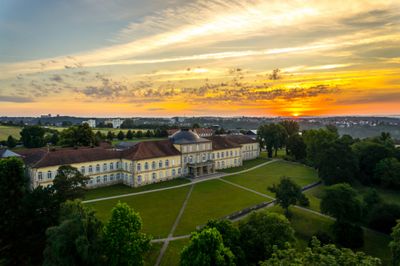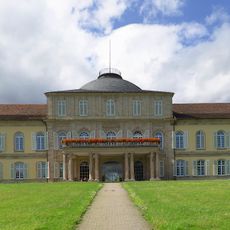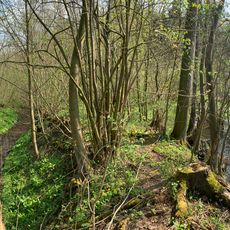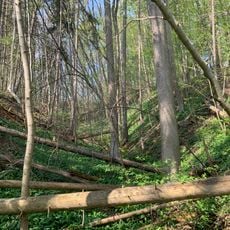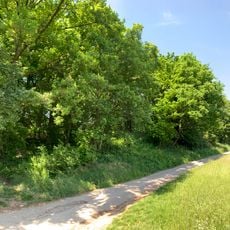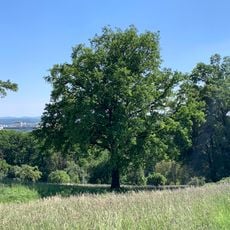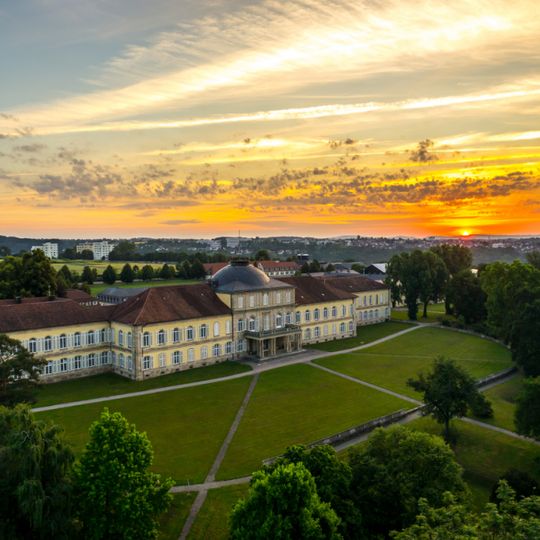
Englisches Dorf Hohenheim, English garden park at University of Hohenheim, Stuttgart, Germany.
Englisches Dorf Hohenheim is a landscape park located within the University of Hohenheim campus in Stuttgart that originally contained roughly 60 small buildings. The layout follows English garden principles with varied architectural styles, though only a few original structures remain in their original locations today.
Duke Carl Eugen and his wife Franziska von Hohenheim began building the village from 1776 as a "rural colony amid the ruins of a Roman city", modelled on English garden art. It comprised 60 miniature buildings at a scale of 1:4. After the duke's death in 1793 it decayed; three objects survive in Hohenheim, others were moved to Ludwigsburg Palace park and Monrepos.
The name Englishes Dorf follows English garden fashion, but the layout staged a "rural colony amid the ruins of a Roman city": the Wirtshaus zur Stadt Rom leaned against a three-arch aqueduct ruin, and a stair from its roof led visitors up for the view. The play equipment, used by adults and children alike, stood scattered across the playground.
The grounds are easily accessible as part of the university campus and can be explored on foot. Visitors should expect that many original buildings no longer exist on site and the landscape is largely defined by modern university buildings.
The village was laid out from 1776 as a "rural colony amid the ruins of a Roman city", with about 60 miniature buildings at a scale of 1:4. The Roman Inn leaned against an artificial three-arch aqueduct, and a staircase from its roof led visitors up for the view. The aqueduct was demolished around 1800 and rebuilt, altered, in Ludwigsburg.
The community of curious travelers
AroundUs brings together thousands of curated places, local tips, and hidden gems, enriched daily by 94,651 contributors worldwide.