Georgenkirche, Church building in Rötha, Germany
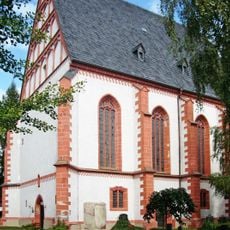
Georgenkirche is a church building in Rotha that combines Romanesque, Gothic, and Baroque style elements into a balanced composition. The octagonal tower with its curved dome forms a distinctive focal point.
The church was built around 1140 as a Romanesque pillar basilica; parts of the outer walls, the nave supports and the west structure planned for two towers survive, though only the north tower was built. In 1510 the Romanesque choir was demolished and replaced by a three-bay late Gothic choir about three times larger. In 1682 the nave was rebuilt as a flat-roofed hall, and the square Romanesque tower received an octagonal Baroque top.
The organ by Gottfried Silbermann shapes the acoustic character of the church and demonstrates the high craftsmanship of the 18th century. Visitors can experience the quality of this instrument directly during concerts.
The church stands in the centre of Rötha, its west front facing the main portal; the Romanesque square tower and the octagonal Baroque top make it easy to find from the market. The interior is entered through the Baroque portals, and the Silbermann organ stands on the west gallery, visible from the nave.
The font of Rochlitz porphyry tuff and its 19th-century baptismal bowl came from the church of Kreudnitz, demolished for open-cast lignite mining; the von Breitenbuch grave slabs came from the demolished church of Cröbern. The 1510 triumphal cross, its 2.20 m corpus left to decay in the roof space, was restored in 2013 and hung inside.
The community of curious travelers
AroundUs brings together thousands of curated places, local tips, and hidden gems, enriched daily by 93,782 contributors worldwide.