Marienkirche, Gothic pilgrimage church in Rötha, Germany
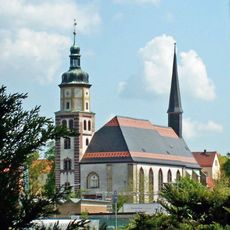
Marienkirche is a late Gothic church building with a five-eighths apse, steep slate roof, and an interior measuring roughly 25 meters long and 12 to 13 meters wide. The structure shapes Rötha's townscape with its vertical form and now serves as a venue for memorial services and musical performances.
Construction of the church began in 1510 following reports of Virgin Mary sightings in 1502 near a pear tree and spring at that location. The building became a pilgrimage destination and has shaped regional religious life for more than 500 years.
The church was first called 'Church of the Holy Pear Tree' after the pear tree and spring where the shepherd's vision occurred. The wing altar, carved around 1525–1530 by the 'Master of Rötha', shows the Coronation of Mary; its side panels depict John the Baptist, the Apostle Andrew, and the helper saints Catherine and Barbara.
The church is located on Marienstraße in Rötha and serves as an active venue for memorial services and concerts featuring its notable organ. Visitors should plan around regular performances to experience the space's particular acoustic qualities.
The net vault's intersections carry plant motifs taken from the Hortus sanitatis, one of the earliest printed medieval herbals; they were uncovered again during the reconstruction of the 1950s. The choir vault closes in a diamond star.
The community of curious travelers
AroundUs brings together thousands of curated places, local tips, and hidden gems, enriched daily by 93,897 contributors worldwide.