Klosterkirche Kemnade, Romanesque church in Bodenwerder, Germany
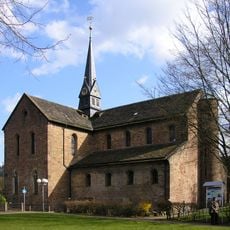
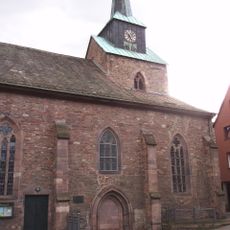
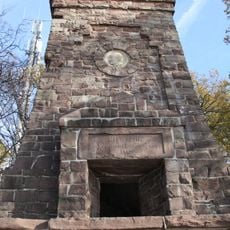
Klosterkirche Kemnade is a flat-roofed, three-aisled pillar basilica on a Latin cross plan with a transept and a distinct crossing, built of rough red sandstone and roofed with sandstone slabs. A rectangular choir bay with an apse adjoins the crossing to the east; the transept arms originally also had apses. The west tower and 20 metres of the nave were demolished, likely after damage in the Thirty Years' War, so the nave is much shorter than its original 53.70 metres.
The building sustained damage during the Thirty Years' War, resulting in the loss of its western tower and sections of the nave. These changes shape its appearance today and show how it redefined itself following this conflict.
The winged altar from the first half of the 15th century shows the birth of Jesus; its wings were added in 1964, and two altars were combined. The Romanesque baptismal font came from St. Johanniskapelle in Tuchtfeld in 1964 and bears no Christian symbols, only a tree relief and a wheel. A simple floor slab in the crossing marks the burial place of Hieronymus Carl Friedrich Freiherr von Münchhausen (1720–1797).
The church is accessible from inside and serves regularly for services of the Evangelical Lutheran congregation of Bodenwerder-Kemnade. Visitors should follow opening hours for visits and respect any ongoing religious events.
A plain stone slab in the floor of the crossing marks the burial place of Hieronymus Carl Friedrich Freiherr von Münchhausen (1720–1797), the "Lügenbaron" whose tall tales were written down by others. Visitors often walk past it looking for the altar and the tombs.
The community of curious travelers
AroundUs brings together thousands of curated places, local tips, and hidden gems, enriched daily by 94,001 contributors worldwide.