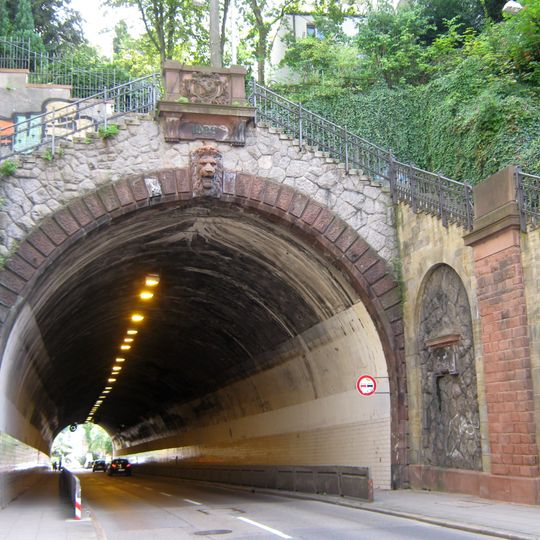
Schwabtunnel, Historic tunnel in Stuttgart, Germany
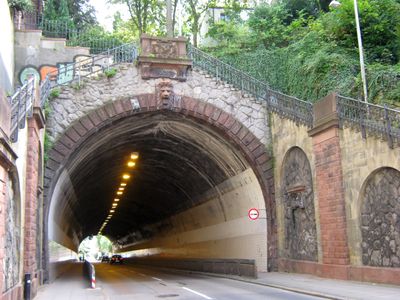
The Schwabtunnel is a 125-metre road tunnel under an eastern spur of the Hasenberg in Stuttgart, sloping between Stuttgart-West and Stuttgart-Süd. Its bore is 10.5 m wide and 6.5 m high, with portals reaching 8.5 m, and carries two lanes plus a footpath on each side. The tube is lined with roughly one million bricks, and both portals bear lion-head keystones dated 1896.
The Schwabtunnel was built between 1894 and 1896 under city building director Carl Kölle to link the working-class Karlsvorstadt in Heslach with the industrial west of Stuttgart, which the Hasenberg separated. Construction cost 289,000 Mark, and the tunnel opened on 29 June 1896. In the Second World War the portals were largely walled up and wooden stands installed, turning it into an air-raid shelter for 2,000 people; the fittings were removed by June 1946.
The tunnel is named after Gustav Schwab (1792–1850), a Stuttgart pastor, poet and publisher. Its two portals carry keystones carved as lion heads with the year 1896 above them, and sculptures by Theodor Bausch: an allegorical group called "Stuttgart" on the Heslach side and a balcony with the city's leaping horse in a cartouche on the Stuttgart side.
The passage is accessible to pedestrians with marked walkways on both sides for those crossing the area. Ventilation and lighting have been designed to handle the volume of daily traffic passing through.
In 1900, an automobile became the first vehicle of its kind to drive through this tunnel, marking a historic milestone in transportation. This moment captured the shift from rail-focused to automobile-based infrastructure development.
The community of curious travelers
AroundUs brings together thousands of curated places, local tips, and hidden gems, enriched daily by 93,532 contributors worldwide.