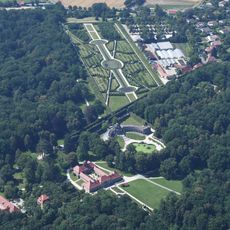
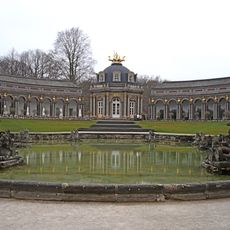
Old château of the Eremitage in Bayreuth, Summer palace in Bayreuth, Germany
The Old Palace of the Eremitage in Bayreuth is a four-wing complex built from 1715, entered through a small grotto on the south side. Its north wing holds a ballroom and the margrave's rooms, while the east and west wings contain simple hermit apartments. The facade kept its ruin-like character after Margravine Wilhelmine's 1735 expansion.
Margrave Georg Wilhelm had the palace built from 1715 as a Lusthaus; the architect was probably Johann David Räntz the Elder, a pupil of Paul Decker, with Johann Heinrich Endrich supervising construction. In 1735 Friedrich gave the Hermitage to his wife Wilhelmine, who extended the north side by five rooms per apartment and kept the ruinous facade. Restored 1928–1935 and again 2005–2009, it has been open to guided tours since.
The name Eremitage comes from the court's hermit game: the margrave and a few courtiers spent days as hermits in huts scattered through the forest and met in the evening in the palace ballroom. Margravine Wilhelmine, who received the estate in 1735, turned the ladies' wing hermit cells into her artistic study.
The Old Palace can only be seen on guided tours; it reopened to visitors after restoration in 2005–2009. The 1928–1935 restoration had partly altered the historic state, so some surfaces seen today reflect that earlier campaign. The building stands in the Eremitage park east of the St. Johannis district, not in Bayreuth's centre.
Two lacquer panels in the Japanese Cabinet were gifts from Prussian King Frederick the Great, serving as valuable evidence of diplomatic relations. These rare East Asian artworks reveal the cosmopolitan taste of the 18th-century court.
The community of curious travelers
AroundUs brings together thousands of curated places, local tips, and hidden gems, enriched daily by 94,340 contributors worldwide.