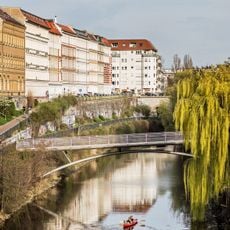
Robert-Koch-Park, Public park in Grünau-Ost, Germany
Robert-Koch-Park is a 25-hectare park in the Grünau-Ost district of Leipzig, bounded by Grünauer Allee, Straße am Park, Nikolai-Rumjanzew-Straße and Schönauer Straße. Its north-western part is occupied by the Parkschloss, a two-storey building with a curved mansard roof, a portico on the north side and a columned rotunda facing the park. The grounds also hold the Robert-Koch-Klinik, ponds and streams, and numerous trees including lindens, oaks, yews, maples and rhododendrons.
The park was established between 1910 and 1913 as a summer residence for agricultural machinery manufacturer Paul Sack. It later transformed into a public park and was named after physician Robert Koch.
The park's name honours Robert Koch, the physician who identified the tuberculosis bacterium; the clinic on the grounds received this name on 1 May 1963. Since 2016 the city has run the annual event series Kultur im Schloßpark. Seven sculptures made in 1985 during the 3rd International Sculptors' Plein Air at the Agra site were placed in the park.
The park lies at the southeastern edge of Grünau, bordered by Grünauer Allee to the north, Straße am Park to the east, Nikolai-Rumjanzew-Straße to the south and Schönauer Straße to the southwest; the official address is Nikolai-Rumjanzew-Straße 100. The grounds are open to the public since 5 October 1984, while the Robert-Koch-Klinik, an outpost of Klinikum St. Georg, still occupies part of the site. The former northeastern entrance of the trial estate stood near today's Leipzig-Grünauer Allee S-Bahn station.
The park's name comes from the Robert-Koch-Klinik built on its eastern side and inaugurated on 20 October 1962 with 184 beds; it received that name on 1 May 1963. The clinic has been an outpost of the municipal Klinikum St. Georg since 2000.
The community of curious travelers
AroundUs brings together thousands of curated places, local tips, and hidden gems, enriched daily by 93,900 contributors worldwide.