St. Anne, Eisleben, Lutheran church in Eisleben, Germany
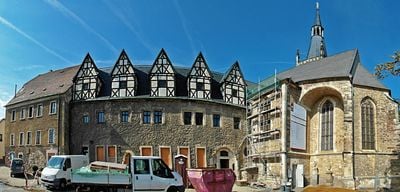
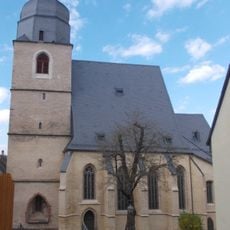
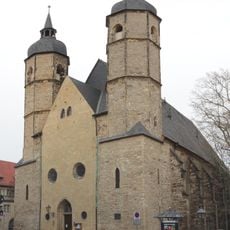
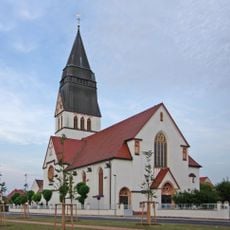
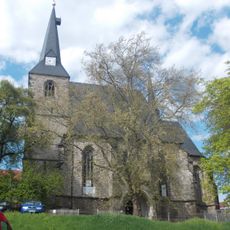
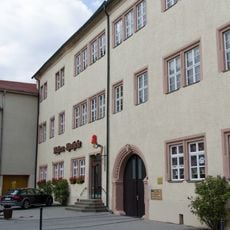
St. Anne in Lutherstadt Eisleben is a hall church with an east and west choir and a five-storey north tower with pointed-arch tracery windows. The east choir is three-sided, the smaller west choir polygonal, both supported by buttresses. A two-storey annex on the south wall of the east choir holds the rib-vaulted sacristy below and the prince's gallery above, lit by a four-part tracery window with 1909 stained glass showing Martin Luther and Martin Rinckart.
Count Albrecht IV founded the new mining town of Eisleben in 1511 and had St. Anne's built from 1513 for its miners; the late-Gothic east choir was consecrated on 13 January 1516 by Archbishop Albrecht of Brandenburg. Martin Luther, as district vicar of the Augustinian reform congregation, visited the attached monastery in 1515 and 1516 and attended its general convent in 1520. Under Caspar Güttel the Reformation spread from here from 1518, and the church became the first Protestant parish church in Mansfeld county. The nave was added between 1585 and 1608 under Countess Margareta of Mansfeld-Hinterort.
The church grew from the miners' new town founded in 1511; from 1518 Caspar Güttel preached the Reformation here, making St. Anne the first Protestant parish church in the county of Mansfeld. The sandstone choir-screen balustrade of the Renaissance seating is known as a "stone picture Bible". Since 2019 the parish has been part of Pfarrbereich Eisleben I with Bischofrode, Helfta and Volkstedt.
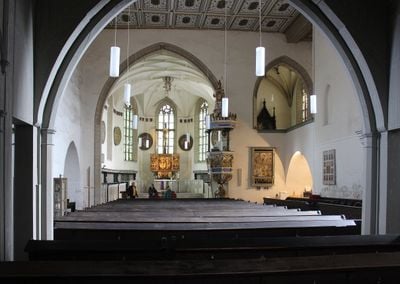
The church stands on a rise in the Neustadt district, with the five-storey north tower and its pointed-arch tracery windows marking the entrance side. Inside, the flat panelled ceiling and the raised pulpit with its blue and gold canopy are best seen from the nave; the apse altarpiece sits at the far end. Ground subsidence from historic leaching caused cracks in the choir and nave, so some areas may be cordoned off.
The choir-stall balustrade, carved from sandstone in the Renaissance, is known as the Steinbilderbibel, the stone picture Bible, because its reliefs lay out biblical scenes in sequence. The late Gothic winged altar, handed to a museum in 1888, was brought back into the church in 1920.
The community of curious travelers
AroundUs brings together thousands of curated places, local tips, and hidden gems, enriched daily by 93,493 contributors worldwide.