Protestant Church, Protestant church building in Liederstädt, Germany.
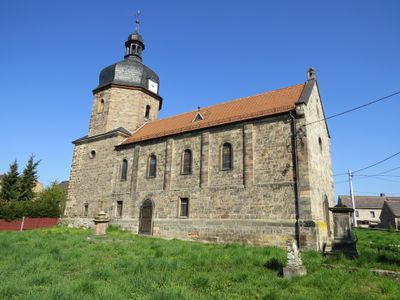
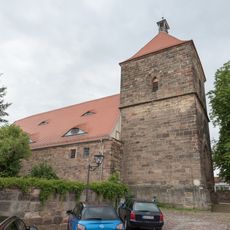
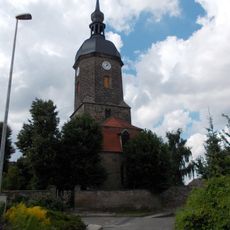
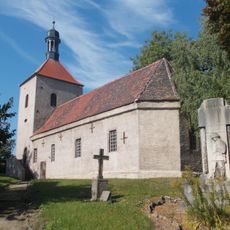
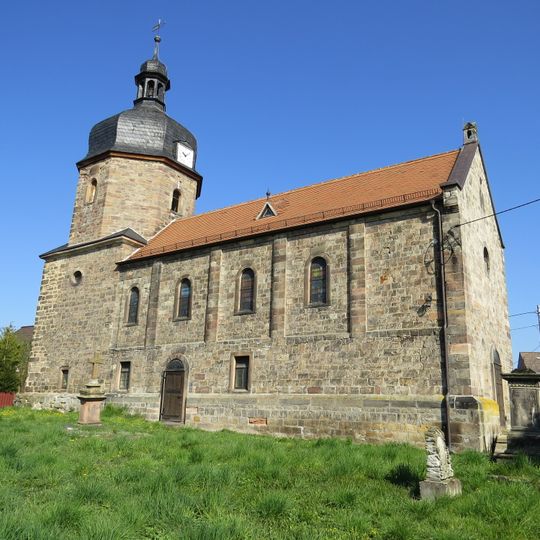
The Protestant Church in Liederstädt is a single-nave hall church with a rectangular nave and a square west tower topped by an octagonal bell chamber with a slate-covered curved spire and lantern. The nave has corner quoins and small round-arched windows, and the east front ends flat with a door and two narrow pointed-arched windows. Inside, a flat dark wooden ceiling spans the space.
The church was built in the 13th century as a branch church of Vitzenburg Monastery, with its west tower dating from that period. After the monastery was dissolved in 1540 during the Reformation, it became a Protestant parish church. In the 18th century the tower received a new bell chamber with a Welsh hood, and around 1880 the nave was enlarged and refitted. The last renovation took place around 1960.
The church belongs to the parish of Liederstädt within the Querfurt parish association of the Merseburg church district, part of the Evangelical Church in Central Germany. Its 13th-century bell, cast around 1275 in a transitional beehive-to-sugar-loaf shape, bears a scratched inscription and pentagrams and is one of the oldest and most valuable bells in the district. Since 2010 it has hung on an electric ringing system with linear drive.
The church stands in Liederstädt, a district of Querfurt in Saxony-Anhalt, at coordinates 51.30885, 11.57972. It is a heritage monument listed under registration number 094 21001. The building is little used, so visits are tied to services and events; tours can be arranged through the church office of the parish, part of the Querfurt parish association in the Merseburg church district.
The oldest bell in the tower was cast around 1275, in a transitional form between beehive and sugarloaf, with a light rib and incised inscription plus cast pentagrams. Tuned to g′, it is one of the oldest and most valuable bells in the Merseburg church district. A second bell from the 14th century disappeared, and a third, cast in 1887 at Ulrich in Laucha, was removed in 1917; in 2010 the surviving bell received an electric ringing system with linear drive.
The community of curious travelers
AroundUs brings together thousands of curated places, local tips, and hidden gems, enriched daily by 93,663 contributors worldwide.