St. Elisabeth, Medieval church in Zeddenick, Germany
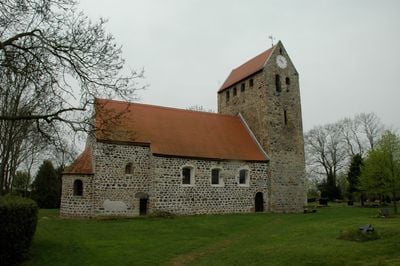
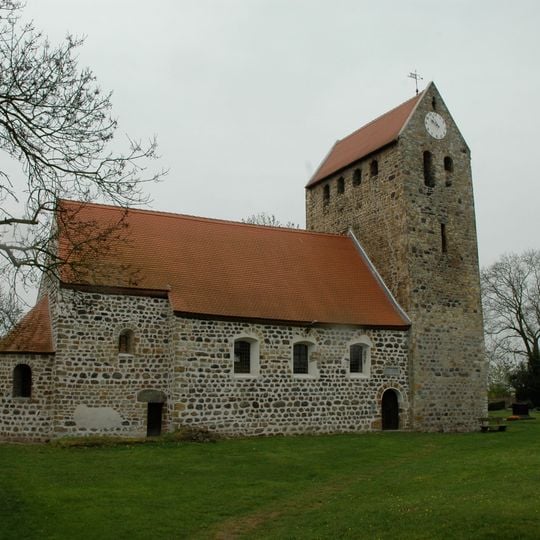
St. Elisabeth in Zeddenick is a Romanesque hall church whose core dates from around 1180. It has a broad rectangular west tower, a long nave, a recessed square choir and a semicircular apse. The tower was raised in quartzite in the late Romanesque period, and the choir walls were heightened in brick in 1769.
The core of the church dates from around 1180, a Romanesque aisleless building with a west tower, nave, square choir and semicircular apse. The fieldstone tower was raised in quartzite in the late Romanesque period, and the choir's wall tops were heightened in brick in 1769. The windows were enlarged in 1747 and 1899.
Originally dedicated to Mary, the church was called Unser Lieben Frauen in 1583 and now bears the name of St. Elisabeth. Inside, a late Gothic St. Christopher survives on the south-east wall of the nave, heavily altered, and the apse holds late Romanesque wall paintings from around 1200, partly replaced by copies on canvas during the 1900–1902 restoration by August Olbers of Hanover.
The church stands in Zeddenick, a district of Möckern in the Jerichower Land, reached by road from Möckern. The nave's long wall has a dark arched side door, and a second dark arched entrance sits at the base of the tower. The interior is covered by a flat wooden ceiling of 1855, and the tower opens to the nave through two round arches.
The tower was raised in quartzite during the late Romanesque period, and its sound openings from that time survive. A bronze bell cast in 1763 by Christian Gotthold Ziegner of Magdeburg carries the donor coat of arms of Ludwig Philipp von Hagen.
The community of curious travelers
AroundUs brings together thousands of curated places, local tips, and hidden gems, enriched daily by 93,519 contributors worldwide.