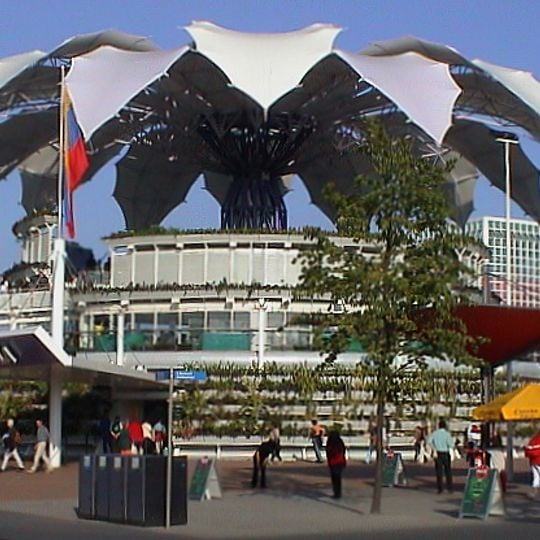
Venezuelan Pavilion Expo 2000, Exhibition pavilion in Hanover, Germany.
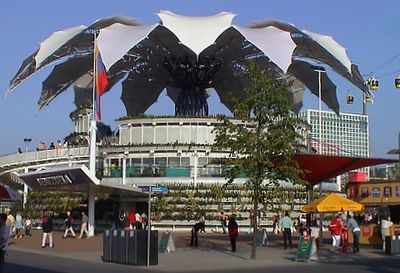
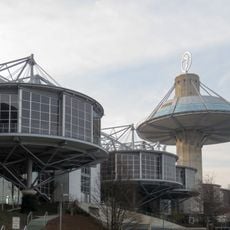
The Venezuelan Pavilion is a three-story cylindrical structure built for Expo 2000 in Hanover. The building combines glass and steel materials arranged in a flower-like form.
Designed by José "Fruto" Vivas with German engineer Frei Otto, the pavilion was built from October 1999 to April 2000 for Expo 2000 in Hanover, next to the Colombian and Mexican pavilions. It was the second most visited pavilion after the German one. Dismantled after the fair, it was moved to Barquisimeto in 2006, rebuilt, opened in 2008, and declared a National Historic Monument in 2013.
The building design by José Vivas incorporates elements of Venezuelan identity through its flower-shaped structure, resembling the national orchid of Venezuela.
The building allows movement between exhibition spaces through a central elevator that connects multiple levels and platforms. Visitors can reach all areas of the pavilion with relative ease.
The 16 petals are woven polyester membrane coated with polyvinyl chloride for water resistance, stretched over eight support points to form each petal's shape. Sixteen synchronized hydraulic cylinders open or close the roof in 90 seconds, and the membrane's semi-transparency lets sunlight reach the plants inside.
The community of curious travelers
AroundUs brings together thousands of curated places, local tips, and hidden gems, enriched daily by 92,758 contributors worldwide.