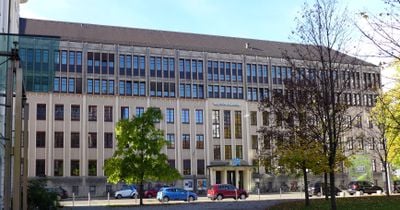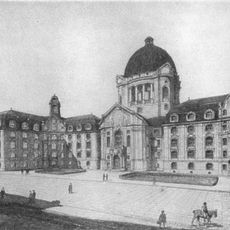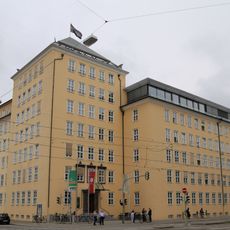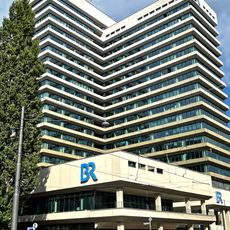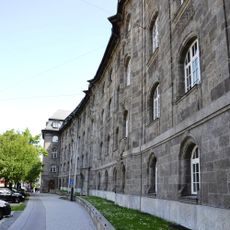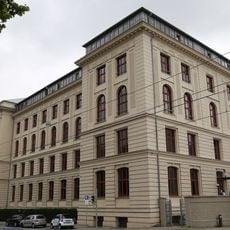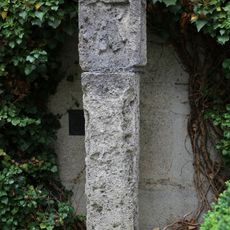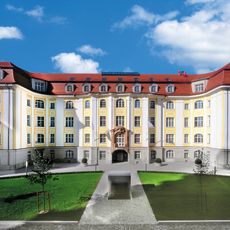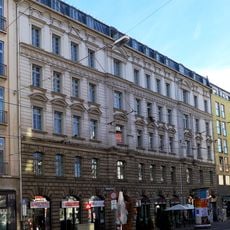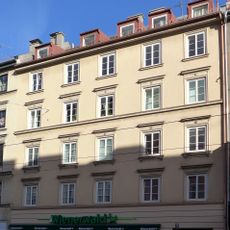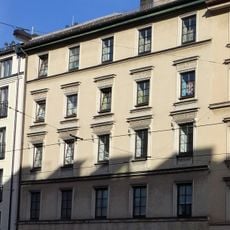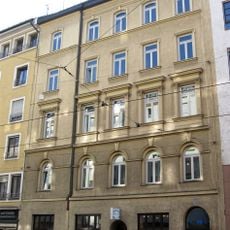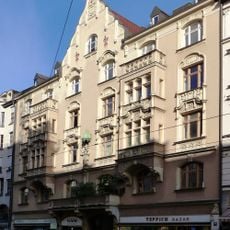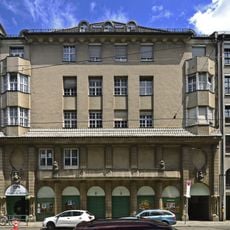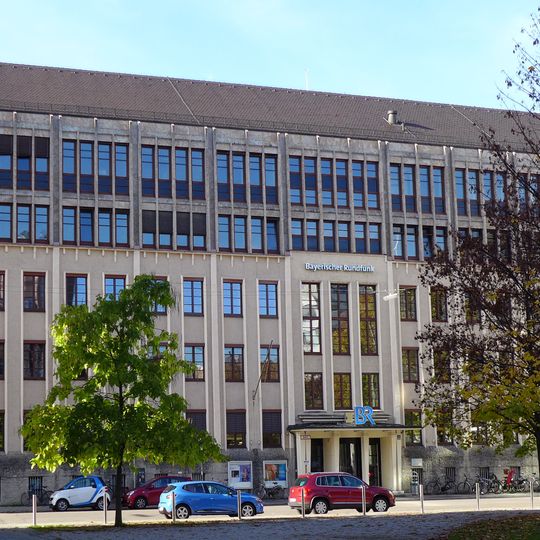
Funkhaus München, Broadcasting building on Rundfunkplatz, Munich, Germany
Funkhaus München, also called the Riemerschmid-Bau, was built in 1928–1929 by architect Richard Riemerschmid as Germany's first building erected solely for radio. The original three-storey structure at the corner of Marsstraße and Hopfenstraße had an administration and rehearsal wing at the front and a broadcast wing set back in the courtyard, holding three main transmission halls. War damage and post-war rebuilding, including a 1977–1979 conversion with added storeys, changed it greatly; the original halls are gone.
Richard Riemerschmid won a restricted architectural competition for a Munich broadcasting house in 1927, and the building was erected in 1928–1929 as Germany's first structure built solely for radio. In 1929 the Deutsche Stunde in Bayern moved in from provisional rooms in the transport ministry. Damaged in the Second World War, it was rebuilt in 1945/46 and on air again from 31 May 1945; it was converted and given extra storeys in 1977–1979 and is a listed monument (D-1-62-000-6027).
The building's three original broadcast halls were never open to the public: the largest served music recordings and spoken scenes, a medium one chamber music, and the smallest spoken lectures. The ceiling of the main hall could be adjusted to absorb or insulate sound, and engineer H. Reiher ran acoustic tests on cross-section models. The south courtyard, better shielded from street noise, was used for outdoor recordings.
The building stands at Rundfunkplatz 1, at the corner of Marsstraße and Hopfenstraße, and is still used by Bayerischer Rundfunk, so interior rooms are generally not open to the public. The original broadcasting halls and recording studios were lost to war damage and post-war rebuilding, so visitors see a structure altered by the 1945/46 restoration and the 1977–1979 conversion and addition of floors.
The largest of the three original broadcast halls had a ceiling that could be adjusted to be sound-insulating or sound-absorbing, and curtains could further alter absorption. Engineer H. Reiher carried out the acoustic calculations, testing on cross-section models. No audience was admitted to the halls, so clothing fabrics played no part in the acoustics.
The community of curious travelers
AroundUs brings together thousands of curated places, local tips, and hidden gems, enriched daily by 94,093 contributors worldwide.